
July 8, 2026
Auto Glass Repair & Replacement Services: Full Guide 2026
Auto glass damage demands fast, informed action to ensure your safety and your vehicle’s integrity. Here’s what you need to know for smarter decisions and safer driving, whether you need quick repair or total replacement.
- Identify auto glass damage early—chips or cracks can quickly worsen, leading to costly repairs and compromising up to 30% of vehicle structure.
- Choose repair or replacement based on safety, size, and visibility—repairs save time and money for minor damage, but replacement is non-negotiable for long cracks, edge damage, or anything blocking your line of sight.
- Ensure ADAS calibration after any windshield replacement—modern vehicles with lane-keeping or collision alerts require precise alignment, with professional calibration costing $150–$600 and always included in a quality shop’s process.
- Prioritize certified providers with AGSC/ASE credentials—visible badges, transparent warranties, and digital calibration reports are your signs of trust for safety and long-term satisfaction.
- Compare mobile and in-shop services wisely—mobile repairs are convenient for small chips away from ADAS sensors, while in-shop service is essential for advanced calibration, structural repairs, or bad weather conditions.
- Document damage and your claims from the start—clear photos and paperwork support smooth insurance coverage, which often pays 100% for chip repairs and may offer zero-deductible replacements in certain states.
- Practice daily preventive care—use ammonia-free cleaners, gentle wiper habits, and shade parking to keep auto glass clear; untreated chips become critical cracks up to 80% faster in extreme weather.
- When in doubt, call a pro—DIY fixes are only safe for small, isolated chips away from critical zones; professional repairs restore structural strength and come with guarantees you can trust.
Engage with the full guide to unlock smart, actionable steps for safer roads, lower costs, and total peace of mind—Clear Vision, Safe Driving.
Why Auto Glass Repair & Replacement Services Matter More Than Ever in 2026
A single pebble on the highway can crack your windshield—and in 2026, windshield chips are the #1 cause of auto glass claims for drivers nationwide.
If you’ve ever spotted a mysterious star-shaped chip or a creeping crack across your field of view, you know how quickly a small problem can become a major safety risk—and a major expense.
That’s because even the tiniest flaw in your auto glass can reduce your vehicle’s structural strength by up to 30%, and leave critical safety systems, like airbags and lane-assist cameras, compromised.
But here’s the good news: knowing exactly what to do the moment you see damage can turn a stressful situation into a straightforward fix—saving you hundreds of dollars and keeping your ride safe and seamless.
In this guide, you’ll unlock the essentials to:
- Spot different types of auto glass damage—and understand their unique risks
- Decide when to repair or replace, based on professional safety standards
- Navigate costs, insurance claims, and legal rights that protect your wallet
- Choose a trustworthy provider who stands behind their work, their credentials, and YOUR safety
- Compare mobile vs. in-shop service to fit your schedule and your car’s technology
- Learn the smartest care habits to keep chips and cracks away for good
We’ll also spotlight the latest advances in ADAS calibration—a must for nearly every vehicle rolling off the lot since 2015. Calibration mistakes can put modern features like emergency braking and collision alerts at risk, so clarity here means real peace of mind.
If you want your auto glass to deliver on its promise—clear vision, safe driving, and a smooth claims process—these insights are your key to making confident, informed decisions every step of the way.
Let’s start by breaking down exactly how auto glass damage happens, and what you should do the moment you spot that first chip or crack.
Understanding Auto Glass Damage: Types, Risks, and Immediate Responses
Every vehicle owner faces windshield worries at some point, and knowing the types of auto glass damage is critical to safe driving.
The most common forms of auto glass damage include:
- Chips: Small dings, usually from flying rocks, often less than a dime in size.
- Short cracks: Cracks under a few inches long, sometimes shaped like lines or stars.
- Long cracks: Any crack over a few inches; these spread quickly and threaten windshield strength.
- Edge damage: Chips or cracks at the glass edge, which spread faster due to structural stress.
- Shattering: Complete glass breakage, often from accidents—leaves sharp fragments and a total loss of visibility.
- Stress cracks: Cracks from sudden temperature shifts or improper installation, typically without an impact point.
“Even a tiny chip can turn into a major safety risk within days.”
How Auto Glass Gets Damaged
Your auto glass faces more hazards than you might think. Damage most often results from:
- Road debris: Rocks or gravel thrown up by tires at highway speeds.
- Accidents and impacts: Collisions, falling branches, or flying objects.
- Extreme temperatures: Very hot or cold weather can cause stress cracks suddenly.
- Improper installation or faulty seals: Weakens the windshield, making damage more likely.
Picture this: You park in the sun, then blast cold AC—the rapid change can cause a stress crack to snake across your windshield before your eyes.
Safety Hazards and When to Act
A damaged windshield does more than block your view—it can:
- Weaken vehicle structure by up to 30%.
- Compromise airbag effectiveness, since airbags bounce off the glass during deployment.
- Distort vision and create glare, especially if cracks are in the driver’s line of sight.
Takeaway: If you notice a new chip, don’t just watch it—act fast. Most repairs take less than an hour and cost $40–$70 for small chips, while ignoring damage could require a full replacement costing up to $1,500 for luxury vehicles.
Immediate Steps to Secure Your Safety
Here’s what to do as soon as you spot damage:
- Secure the area: Park safely, avoid slamming doors, and keep pressure off the glass.
- Avoid stress: Don’t blast heat or AC on the damaged spot—sudden changes invite more cracks.
- Document with photos: Take clear, close-up pictures from multiple angles; this is especially helpful for insurance purposes.
- Cover chips or cracks: Use clear tape (never duct tape or silly putty) to keep out dirt and moisture until a pro can evaluate.
Refer to our companion guide for in-depth repair scenarios and step-by-step emergency actions.
Being proactive about auto glass damage ensures clear vision and safe driving—and fast action can save you both time and money.
Repair vs. Replacement: Making the Safe, Informed Choice
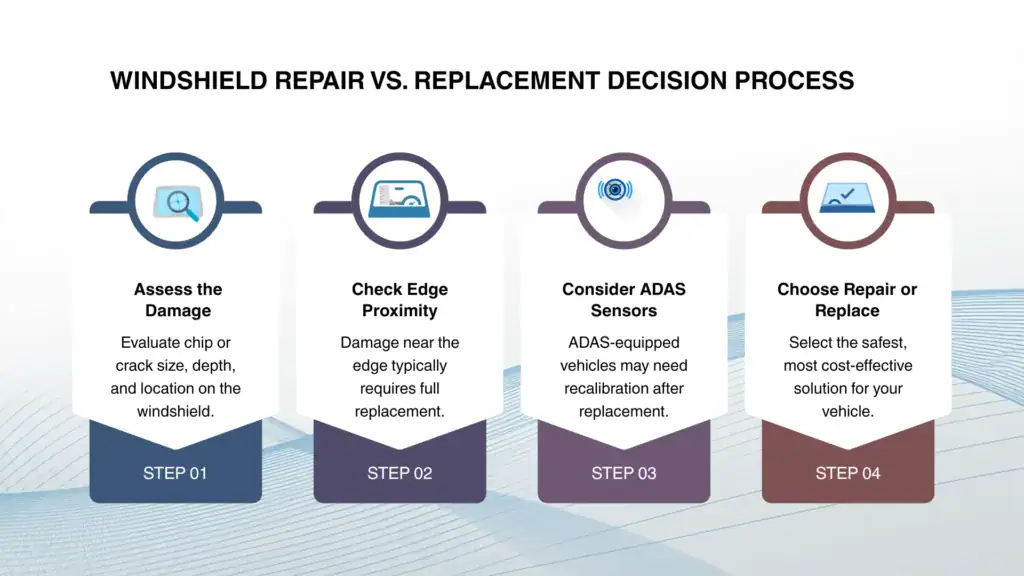
Auto glass damage isn’t always a clear-cut fix—knowing when to repair vs. replace keeps you safe and can save time, money, and stress.
A professional assessment looks at the size, type, and position of damage, plus how deep it goes into the glass layers.
Key Factors: Repair or Replace?
Technicians use precise criteria to decide if repair is both safe and effective:
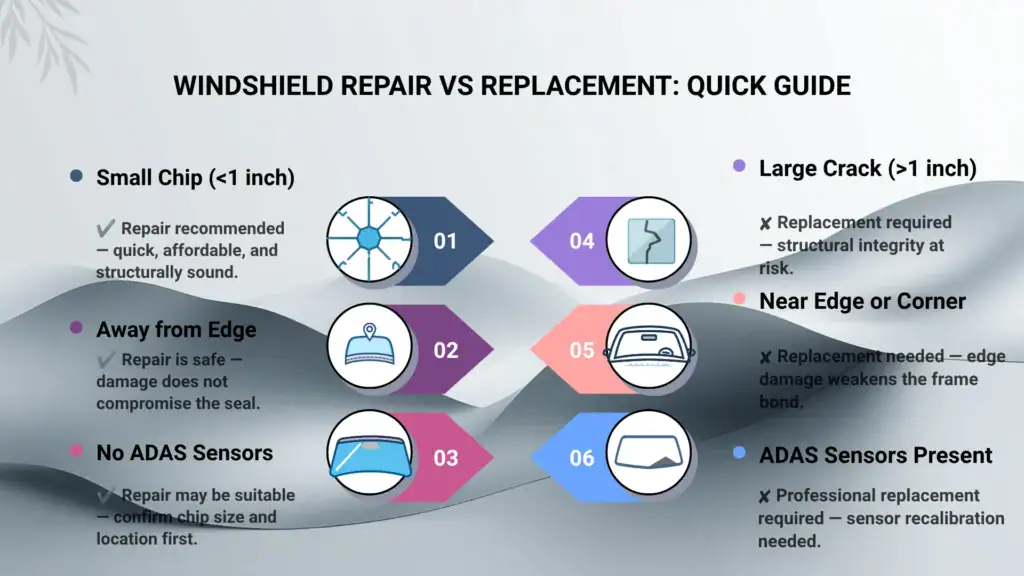
- Chip or crack is smaller than a credit card (about 3 inches or less)
- Damage is not in the driver’s direct line of sight
- Crack does not reach the glass edge (edge cracks spread faster)
- Number of chips/cracks is limited (typically, only 1-2 minor chips)
- Only the outer layer is damaged (inner glass or vinyl layer intact)
If you see a long crack, edge damage, spiderwebbing, or distortion in your line of sight, replacement is the only safe route.
Visual Examples: What Can Be Fixed
Picture this:
- A pea-sized rock chip on the passenger side—quick repair possible.
- A crack arching from edge to edge—must be replaced, no question.
Imagine a transparent overlay diagram showing these common scenarios for an instant “safe/not safe” check. Shops increasingly use digital inspection reports to share annotated photos, helping you understand the recommendation.
Safety First: Why Professional Input Matters
Only a trained technician can reliably spot when hidden structural risks or damage beneath the surface mean repair isn’t enough.
Industry guidelines (AGSC 2026) say, “If repair cannot restore both strength and clear vision, replacement is mandatory to keep you and your passengers protected.”
Never gamble with a crack near an airbag zone or a chip that’s widened—a professional evaluation is your best defense against future issues.
Essential Takeaways You Can Use Now
- Don’t guess—send clear photos to a trusted shop and get an exact recommendation.
- Repair saves time and cost if the damage is minor, but replacement restores safety when structure or clarity is compromised.
- “When in doubt, safety comes first—clear vision means safe driving.”
To make the safest, most cost-effective choice, always start with a certified technician’s evaluation. The right call today leads to fewer headaches (and zero surprises) tomorrow.
Step-by-Step Overview: Professional Auto Glass Repair & Replacement Processes
The Professional Windshield Repair Process
Picture this: a chip appears in your windshield from flying debris on the highway. A professional shop gets you safely back on the road in under an hour.
The standard repair steps include:
- Clean and prep the glass, often opening the damaged spot for optimal results
- Vacuum and inject premium resin, ensuring it fills every micro-crack
- Cure the area with UV light, solidifying the resin and bonding it structurally
- Polish and finish, making the repaired area almost invisible
Most repairs take under 60 minutes. The main goals are to restore windshield strength and prevent cracks from growing—cosmetic perfection is a bonus.
Repairs are highly effective for chips and short cracks that aren’t in the driver’s primary field of vision. However, if the damage goes to the windshield’s edge or blocks your view, replacement is the safest route.
The Windshield Replacement Process in 2026
When your glass damage is too severe for repair, the 2026 windshield replacement process follows strict quality and safety standards.
Professionals now follow these precise steps:
- Prepare your vehicle: Protect paint and interior surfaces
- Remove all damaged glass using specialized tools to avoid further harm
- Prep the frame (pinch weld): Clean, prime, and check for rust
- Install the new windshield: Apply a high-grade urethane adhesive, fit the glass to exact factory specs
- Allow for cure time: Wait for urethane to set—a safe drive-away is only guaranteed after this window
- Complete final checks: Test for leaks, refit trim, and ensure all safety systems work
Shops now routinely calibrate ADAS systems (like auto-braking and lane keeping) after installation, as recommended by most manufacturers. This ensures every sensor works as intended for your vehicle’s protection.
Quality Standards, Materials & What to Expect
You’ll have options for OEM, OEE, or aftermarket glass, each meeting federal safety requirements but differing in price, fit, and sometimes sound/thermal performance.
Certified technicians (often AGSC or ASE) handle every stage, and reputable shops are upfront about material quality, technician credentials, and warranty coverage.
Key point: Don’t drive away until the shop confirms cure time and all ADAS features operate normally.
A well-done repair or replacement means maximum windshield strength, zero leaks, and full visibility—plus documented safety for your peace of mind. Quality auto glass service blends craftsmanship, high-grade materials, and process transparency, keeping you and your passengers safe with every mile.
Integration with ADAS (Advanced Driver-Assistance Systems): Calibration & Safety Compliance
Modern vehicles now rely heavily on Advanced Driver-Assistance Systems (ADAS)—think lane keep, auto braking, and collision alerts—that need precise windshield placement and exact calibration. If your vehicle was built after 2015, there’s a high chance cameras and sensors are directly connected to or embedded in the windshield.
A single millimeter’s misalignment during a glass install can throw off radar or camera accuracy, potentially putting driver and passenger safety at risk. Factory-level installation and calibration are now essentials, not extras.
Types of ADAS Calibration & When They’re Mandatory
| Calibration Type | Average Cost | Time Required | When It’s Needed |
|---|---|---|---|
| Static Calibration | $150+ | 30–60 minutes | In-shop, using precise targets for vehicles requiring fixed-position sensor alignment |
| Dynamic Calibration | $100–$250 | 30–60 minutes (plus test drive) | Requires a specially equipped test drive with scan tools to recalibrate cameras in motion |
| Combined Calibration | $250–$600 | 60–120 minutes | Needed when a vehicle requires both static and dynamic methods for full ADAS accuracy |
ADAS calibration comes in two main forms, and sometimes both are required for 2026:
- Static calibration:
Done in-shop using precise targets.
Often costs around $150+.
- Dynamic calibration:
Involves specially equipped test drives and scan tools.
Ranges from $100 up to $250.
- Combined calibration:
Some vehicles need both, pushing calibration costs to $250–$600 total.
- Always required:
- After any windshield replacement on vehicles with lane, brake, or camera-driven features
- Whenever the vehicle manufacturer or insurer mandates it
What Quality Shops Do for ADAS Calibration
Picture this: Your new windshield is in, but the job isn’t done. Top shops will:
- Run a pre-scan and post-scan, producing digital reports for both
- Photograph their target setup and calibration screens for your records
- Adhere to OEM procedures, not shortcuts
- Document results so insurance claims are quick and complete
Shops with clear, step-by-step paperwork build trust and prove that every system is back in factory spec.
What to Ask Before Scheduling Service
Don’t risk your safety or your wallet—ask these questions every time:
- “Will my ADAS need calibration after replacement?”
- “Is calibration done here, or does the vehicle go off-site?”
- “Will I get full documentation confirming successful calibration?”
- “Will the insurance pay for this process—and will you coordinate that for me?”
These conversations are now as vital as asking about the glass brand.
Consumer Protections and Insurance Facts
By law in most states, insurance must cover complete safe repairs—that includes calibration if the system requires it. If an insurer balks, you’re legally entitled to written denial citing your policy and may contest it.
Fact: Shops are increasingly required to be officially certified to bill insurance for ADAS glass work.
When ADAS is in play, the margin for error drops to zero. Calibration isn’t an upsell; it’s your safety net.
For every driver, the big takeaway: “Proper calibration after auto glass replacement is essential. Don’t compromise—always choose fully certified providers who guarantee ADAS calibration compliance.”
Costs, Insurance, and State-Specific Rules for Auto Glass Services in 2026
Comparative Cost Breakdown: Repair versus Replacement
Auto glass service prices in 2026 remain straightforward, but vary by vehicle and glass type.
For chip repair, most drivers pay $40–$70 per chip, with extra chips adding about $10 each.
Windshield replacement costs average about $450, but can range from $250 to $1,500+ depending on your car.
Picture this: A Ford F-150 owner pays around $400–$800 for a replacement, while a Tesla driver might see costs as high as $1,200 due to specialized glass.
| Vehicle Type | Typical Cost Range | Key Notes |
|---|---|---|
| Sedan (Camry, Accord) | $250–$500 | Most affordable |
| SUV (RAV4, Explorer) | $350–$700 | Larger glass, more panels |
| Truck (F-150, Silverado) | $400–$800 | Size & feature-dependent |
| Luxury (BMW, Audi) | $500–$1,500 | Often requires OEM glass |
| Electric (Tesla, Rivian) | $500–$1,200 | Limited aftermarket options |
OEM, OEE, and Aftermarket Explained
OEM (factory) windshields cost the most—$400–$1,500—but are exact factory matches.
OEE (original equipment equivalent) is nearly identical but not branded, costing about $300–$400.
Aftermarket glass meets federal standards but may lack specialty coatings, running $200–$300.
Selecting the right type isn’t just about price—insurance, warranty, and ADAS compatibility are all key.
“Choose wisely: the glass you pick affects your car’s safety, insurance coverage, and future resale.”
Navigating Insurance Claims and Legal Rights
Under typical comprehensive policies, glass repairs are often covered 100% with zero deductible.
For replacement, your standard deductible applies—unless you’re in states like:
- Florida, Kentucky, South Carolina: Zero-deductible windshield replacements are guaranteed by law.
- Arizona, Massachusetts, New York, Minnesota, Connecticut: Insurers must offer zero-deductible glass coverage as an add-on.
You always have the right to:
- Choose your repair shop
- Request OEM parts (sometimes at extra cost)
- Demand certified ADAS calibration if your car needs it
Legislation is trending toward mandatory facility accreditation, more transparent claims, and stronger consumer protections.
Visualize filing a glass claim and getting a prompt, professional repair—that’s what the best providers deliver every time.
Key Takeaway
“Know your numbers, know your rights.” The right glass, covered by up-to-date insurance and installed by certified pros, means safer roads and fewer headaches. Check your policy, compare local shops, and always document your claims—because clear vision is safe driving.
Choosing a Trustworthy Auto Glass Provider: Credentials, Trust, and Customer Experience
Selecting the right auto glass provider is about more than price—it’s about safety, expertise, and service you can trust.
Top shops always display the following credentials:
- AGSC Certification (Auto Glass Safety Council) demonstrates compliance with leading safety standards.
- ASE or Dow training means technicians have up-to-date skills with adhesives and technology.
- Facility safety accreditations and regular inspections ensure strict quality controls.
Picture this: A certified technician in a crisp blue uniform, AGSC badge visible, confidently reviewing your vehicle—peace of mind starts with visible proof of training.
Look for Experience With Your Vehicle and ADAS
Not all auto glass is created equal, especially for vehicles equipped with ADAS (Advanced Driver-Assistance Systems).
For true expertise, your provider should:
- Have demonstrated experience with your make/model, including any embedded ADAS tech
- Use the right procedures for ADAS camera calibration, backed by pre/post scan documentation
- Stay current with 2026 safety standards, because even a single mistake can disrupt airbags or lane assist
A single missed calibration can lead to failed safety features—always ask for calibration reports with your paperwork.
Service Quality Benchmarks: Warranties, Quotes, and Customer Care
What separates the best from the rest?
- Strong warranties on both glass and labor—expect coverage for leaks and workmanship
- Transparent quotes—no surprise fees; everything is explained up front
- Responsive customer care, with real people ready to answer your questions and coordinate insurance
Imagine reading five-star reviews citing prompt callbacks, polite updates, and a spotless car return. That’s the level of attention high-standard shops provide.
Provider Comparison Tools and Regulatory Expertise
Leading shops make your life easier by:
- Coordinating directly with your insurance including full calibration documentation for ADAS
- Keeping up with state rules and certifications, so you never worry about compliance
- Offering digital tools—instant quote wizards, mobile service filters, and up-to-date review galleries
Before you book, check for:
- Visible badges or certifications on the provider’s website
- A fast, clear quote process
- Verified, recent customer testimonials matched to your vehicle type
A trustworthy shop stands out by combining national credentials, local reputation, and true customer-first service—so your experience is as secure and clear as your new windshield.
Takeaway: Prioritize providers with recognized certifications, proven ADAS calibration expertise, and a commitment to safety and transparency. Your choice isn’t just about glass—it’s about driving with total confidence, today and every day.
Mobile vs. In-Shop Service: Convenience, Safety, and Suitability
Choosing between mobile and in-shop auto glass service comes down to what’s safest and most practical for your situation.
More than 50% of windshield repairs in 2026 are now performed via mobile service—bringing professional tools and certified expertise directly to you, whether at home, work, or even in a well-lit parking lot.
When Mobile Service Is the Smart Choice
Mobile service works best when:
- The repair is a small chip or short crack away from the edges or ADAS sensors
- Weather is mild and dry (urethane adhesives require correct temps and humidity)
- Your car does not need specialized ADAS calibration that requires in-shop targets or scanning
- Convenience is a priority and you need speedy, on-the-go solutions
For most small chips, mobile professionals can finish the work in under 60 minutes—often with no surcharge for coming to your location.
“Picture this: a certified technician arrives at your office parking lot—within an hour, your windshield is restored and you’re back on the road with clear vision and full confidence.”
When In-Shop Is Non-Negotiable for Safety
Some situations demand in-shop service for safety and precise outcomes.
Choose in-shop for:
- Full windshield replacements on vehicles with lane departure, collision warning, or other ADAS tech requiring static or dual calibration (average calibration cost: $150–$600)
- Larger cracks, edge damage, or structural repairs that require advanced tools
- Older vehicles with rusted frames or where indoor climate control is necessary for proper bonding
- Rainy or freezing weather, as adhesives may not cure properly outdoors
“If your vehicle’s safety features depend on precise sensor calibration, only an in-shop environment delivers the accuracy modern vehicles demand.”
Quality, Support, and What to Expect
With both mobile and in-shop auto glass services, expect:
- Technicians who are certified and use OEM-or-better adhesives
- Transparent warranties covering leaks and defects
- Professional scheduling, with most mobile appointments available within 24–48 hours
After service (regardless of location):
- Confirm there are no leaks, strange noises, or warning lights
- Receive clear paperwork, including ADAS calibration reports if performed
Memorable Takeaways for 2026
- “Mobile repairs bring certified safety to your driveway, but in-shop delivers the highest standard when ADAS features are in play.”
- Visualize quick, professional support—whether you need speed or the safety of a certified facility.
- No matter which you choose, make sure the provider prioritizes your safety, clarity, and documentation every step of the way.
The most important decision? Match your service type to the damage, your car’s technology, and weather conditions to keep your vision clear and your vehicle protected.
Preventive Care & Maintenance: Protecting Your Auto Glass Investment
Keeping your auto glass in top shape is simpler than you think—and it’s the safest choice for every driver.
Studies show that chips left untreated can turn into full windshield cracks up to 80% faster in extreme heat or cold.
A tiny chip today can become a costly replacement tomorrow, so early action matters.
Essential Daily Auto Glass Care
Set yourself up for long-term clarity and safety by building smart habits:
- Clean glass regularly with ammonia-free cleaner and soft microfiber towels
- Replace wiper blades every 6–12 months to avoid scratches (worn wipers are a leading cause of “haze” and fine scratches)
- Park in shaded, covered spots to protect glass from sun-induced stress and temperature swings
- Operate window switches gently—avoid slamming doors with windows partially down, as vibrations often worsen small chips
Keeping a clean windshield is about more than looks: Clear glass supports all your ADAS sensors and cameras, especially in modern vehicles.
Seasonal & Environmental Protection Tips
Your auto glass faces new risks with every season and region:
- Winter: Remove ice using plastic scrapers, not hot water—thermal shock can trigger cracks
- Summer: Use sunshades and “crack-safe” parking angles (facing away from direct sunlight if possible)
- High debris zones: Leave extra space behind trucks and avoid tailgating—80% of windshield chips happen on highways and busy routes
Consider applying a hydrophobic coating for added resistance to road grime and rain, supporting both visibility and easy cleaning.
Spotting Early Damage & Acting Fast
- Look for small chips, “stars,” or microcracks after every highway drive or hailstorm
- Feel along the glass edge for tiny imperfections—edge splits are tougher and more expensive to fix
- Snap a photo and call a certified shop if you spot anything; most insurance policies cover chip repairs 100% since it prevents major claims
“Picture this: a single overlooked pebble impact costs just $40–$70 to repair today, but a missed chip can lead to a $400–$1,200 replacement if ignored.”
Advanced Preventive Strategies
- Follow your carmaker’s manual for annual glass inspection
- Ask trusted shops about chip-sealing packages—some now offer multi-year warranty maintenance plans
- Check guides or YouTube for proper cleaning technique to avoid accidental scratching or chemical damage
Choosing prevention today is the most affordable way to protect your safety and your wallet.
Regular checks and fast response transform a potential crisis into a ten-minute fix, letting you drive with confidence every day.
DIY vs. Professional Repair: Risks, Tools, and Making the Right Choice
When faced with auto glass damage, the first question is almost always: Can I fix this myself, or do I need a pro?
DIY repair kits, found at most auto parts stores for $10–$40, promise fast fixes for small chips and cracks. For minor, shallow chips away from the driver’s line of sight, a DIY kit may prevent further spreading, especially if tackled quickly. The average time investment is about 30–45 minutes—but “as good as new” is rare with kits.
Capabilities and Limits: DIY Kits Versus Professional Repair
DIY kits are best for:
- Single, small chips (under the size of a quarter)
- Short cracks (usually 3 inches or less)
- Non-structural glass and areas away from ADAS sensors
However, professional repair is essential when:
- Cracks are long, located at the windshield edge, or in the driver’s line of sight
- Multiple chips or spreading cracks are present
- The damage is near embedded technology (ADAS cameras/radar)
“Every windshield is a safety component—poor repairs can put you at risk.”
Professional repairs average $40–$70, restore structural strength, and include a clear inspection for hidden damage.
Safety Outcomes & Material Quality
Professional glass shops use high-grade resins, controlled vacuum/pressure systems, and UV curing—delivering repairs that last. Kits often lack these features, resulting in repairs that sometimes fail after a few months.
“Picture this: Your chipped windshield distorts a stop sign at dusk, and you’re unaware until it’s too late—a pro fix could mean the difference between hazard and peace of mind.”
Key differences in results:
- Pros guarantee restoration of strength—vital for airbag support
- DIY may reduce the spread, but rarely restores full clarity or safety
Quick Checklist: DIY or Call a Pro?
Ask yourself:
- Is the chip smaller than a quarter, and not on the edge or in my line of sight?
- Is the crack shorter than 3 inches with no webbing or additional damage?
- Is there no ADAS camera, sensor, or electronics near the damage?
If you answered “no” to any, it’s wisest to contact a certified expert.
Resources For Deeper Guidance
For a practical repair toolkit rundown or step-by-step guides, see our Auto Glass Tools Explained and DIY Repair Walkthrough resources—ideal for safe, informed decisions.
The right choice is always safety first: DIY works in select, low-risk cases, but when in doubt, trust a professional for clear vision and safe driving.
Practical 2026 Action Plan: Your Step-by-Step Guide for Auto Glass Service
When auto glass damage happens, a quick, confident response saves you time, money, and maximizes safety—every step counts.
Start with this actionable checklist to help you navigate repair or replacement efficiently:
- Assess & document the damage
- Snap clear, close-up photos of chips or cracks.
- Note the location, size, and whether it’s near the glass edge or in the driver’s line of sight.
- Review your insurance coverage
- Check if you have comprehensive coverage and if your state offers zero-deductible glass replacements (like Florida, Kentucky, or South Carolina).
- Look for ADAS recalibration coverage, especially if your car is from 2015 or newer.
- Select a reputable provider
- Prioritize AGSC/ASE-certified shops with positive reviews, transparent quotes, and proven ADAS expertise.
- Use comparison tools to evaluate local options on price, reviews, and availability.
Ask These Key Questions Before Work Begins
Before authorizing any repair or replacement, protect your interests by asking:
- “Can this be safely repaired, or does it require replacement—and why?”
- “Does my vehicle require ADAS calibration? If so, is it done in-house or by a specialist?”
- “What glass type will you use (OEM, OEE, aftermarket)? What kind of warranty is included?”
These questions set expectations and reinforce your focus on professionalism, reliability, and safety.
After Service: Safety Checks & Documentation
To ensure lasting results and protect your investment, always:
- Confirm the technician provides clear instructions for safe drive-away time (often 30-120 minutes, depending on urethane).
- Verify there are no leaks, dashboard lights, or ADAS errors—test your advanced features before leaving.
- Retain all paperwork and calibration reports, as these support future claims or resale value.
Picture this: A well-lit repair shop, a friendly tech conducting a quick ADAS calibration, handing you a certificate with your warranty details—confidence in every detail.
Key Takeaway for 2026 and Beyond
By following this step-by-step approach, you ensure safe, lasting repairs and clear vision wherever you drive. “Document, ask, verify”—three actions that turn stressful glass damage into a stress-free service experience. Partnering with a respected shop today preserves your safety, your investment, and your peace of mind every mile ahead.
Your Roadmap to Lasting Clarity and Confidence
Clear, properly maintained auto glass is foundational to your vehicle’s safety—and your confidence behind the wheel. By choosing expert care and acting early, you ensure that every drive is protected by the latest technology, uncompromising quality, and the highest safety standards.
You have the power to turn routine glass issues into seamless solutions. Your next steps safeguard both your vehicle and your peace of mind.
—
Key Actionable Takeaways:
- Prioritize immediate action—even minor chips or cracks need a swift, professional assessment
- Insist on AGSC/ASE-certified technicians and full ADAS calibration for modern vehicles
- Use transparent, documented providers—demand clear quotes, calibration records, and warranties
- Protect your investment: clean glass weekly, replace wiper blades often, and address new damage within days
- Explore your insurance rights—request zero-deductible repairs and always choose your trusted shop
—
Ready to take control of your auto glass safety? Here’s how you can act today:
- Snap photos and review your insurance policy for glass coverage
- Book a professional inspection with a certified shop—ask for digital calibration and warranty details
- Set a reminder for regular glass checks, and never delay routine care
—
Your vehicle deserves clarity, safety, and care—because every mile counts, and your vision comes first.
Drive forward with total confidence, knowing that the choice you make today protects every journey ahead.
Clear vision is safe driving—embrace it, demand it, and experience the road with absolute peace of mind.
“Safety isn’t an option—it’s the standard you set every time you choose the right auto glass care.”
FAQ
- How much does auto glass repair and replacement cost in 2026?
Auto Glass Repair & Replacement Services typically range from $40–$70 for a chip repair to $250–$1,500+ for a full windshield replacement, depending on your vehicle type and glass options. - Will my insurance cover auto glass repair or replacement?
Most comprehensive policies cover Auto Glass Repair & Replacement Services at 100% for chip repairs, and several states offer zero-deductible windshield replacements. - Do I need ADAS calibration after a windshield replacement?
Yes—if your vehicle has lane-keeping or collision alert features, Auto Glass Repair & Replacement Services must include static or dynamic ADAS calibration to keep safety systems accurate. - Can I repair a small windshield chip myself?
DIY kits work for minor, shallow chips, but professional Auto Glass Repair & Replacement Services are recommended for cracks near the edge, in your line of sight, or close to ADAS sensors. - Should I choose mobile or in-shop auto glass service?
Mobile options suit small chips away from sensors, while in-shop Auto Glass Repair & Replacement Services are best for full replacements requiring ADAS calibration or structural repair.
Thank you for choosing Discount Auto Glass. Fast, reliable service with a lifetime guarantee. Visit us or enjoy our mobile service.