July 8, 2026
How to Choose the Right Auto Glass Repair Shop (2026)
Choosing the right auto glass repair shop in 2026 is a safety-critical decision, impacting both your driving security and your vehicle’s value. Here are the most essential, actionable insights to help you confidently select a trusted provider — for clear vision, safe driving, and hassle-free service.
- Prioritize ADAS calibration expertise—ensure your shop can handle advanced driver assistance systems, as improper recalibration causes up to 70% of post-repair sensor issues.
- Insist on OEM or certified glass—genuine parts protect your car’s structural integrity and meet insurance and manufacturer standards for safety.
- Demand a detailed written estimate—line-by-line pricing with glass type, ADAS work, and all fees prevents hidden costs and signals trustworthy business practices.
- Verify strong warranties and clear coverage—top shops provide written lifetime workmanship guarantees and at least a 1-year warranty on materials, ensuring no leaks or defects.
- Check for transparent insurance handling—choose providers who offer direct billing to insurers and handle all claims paperwork, eliminating customer headaches and delays.
- Scan customer reviews for specifics—read feedback about ADAS fixes, service response, and lasting results, not just generic 5-star praise or recent review spikes.
- Trust professionalism at every step—clean, organized facilities, certified staff, and clear branding reflect a commitment to safety and long-term reliability.
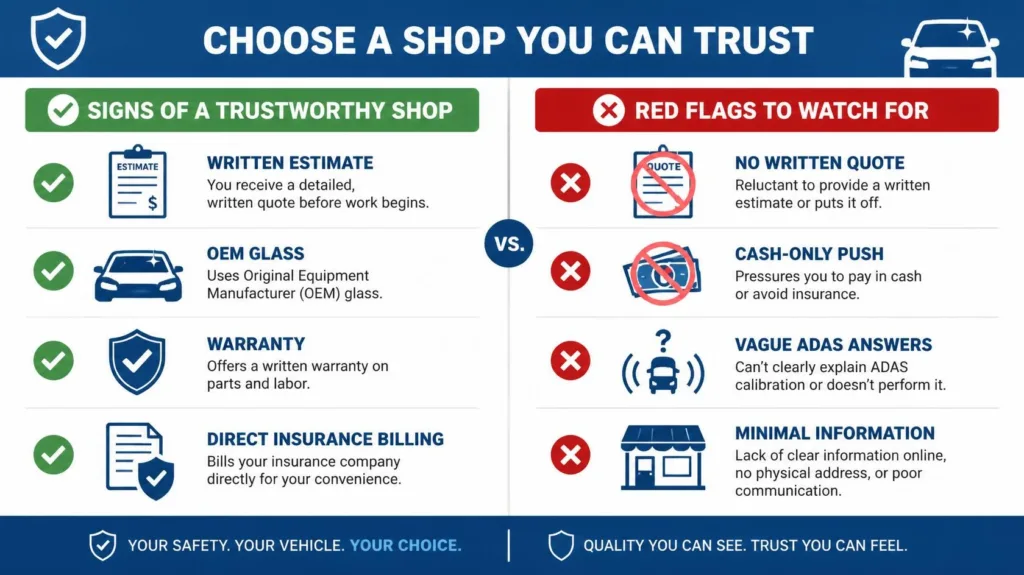
- Walk away from red flags—never settle for providers who give no written estimate, dodge ADAS questions, or push cash deals to avoid insurance.
For complete peace of mind, dive into the full guide to see how expert shops protect you through clarity, transparency, and uncompromising safety at every stage.
Why the Right Auto Glass Repair Shop Protects More Than Your Windshield
You’re driving to work when—crack!—a stray pebble nicks your windshield. At first, it’s just a minor inconvenience. But did you know your windshield could be responsible for up to 30% of your vehicle’s structural integrity in an accident?
A quick fix might seem tempting, but your next choice could impact far more than your view.
The right auto glass repair shop isn’t just about flawless installs—it’s your frontline defense for driver safety, lasting value, and keeping key technology (like lane-keeping and collision sensors) in top shape. Still, in 2026, driver-assist systems and insurance claims have made auto glass repairs far more complex—and the wrong move can actually compromise your protection on the road.
Here’s what you stand to gain when you know what matters most:
- Confidence that your windshield supports airbag timing and crash safety as designed
- Peace of mind knowing your ADAS features (like cameras and sensors) work after installation
- Hassle-free insurance handling, with no surprise bills or paperwork chases
- Service from trusted experts who stand behind their workmanship and explain every step
But if you don’t ask the right questions, you risk glare, leaks, failed sensors—or even a voided warranty.
In this guide, you’ll discover exactly how to:
- Spot the key signs of professionalism and technical skill
- Compare repair shops on service, materials, and support
- Avoid costly mistakes—or the stress of choosing an unqualified provider
Your windshield is more than glass; it’s a promise of clarity, safety, and trust—for you, your passengers, and every mile ahead.
Let’s explore how your choice of repair shop directly protects your safety (and your investment), starting with why shop selection matters more than ever before.
Understanding Why Shop Choice Matters for Auto Glass Repair
Proper auto glass repair isn’t just about fixing a crack—it’s a critical safety decision every driver faces.
Your windshield supports nearly 30% of your car’s structural integrity during a rollover and is central to airbag deployment timing. Choosing the right shop directly affects your safety, vehicle value, and even insurance coverage.
The Role of Auto Glass in Vehicle Safety
High-quality glass and expert installation protect you and your passengers in emergencies.
Picture this: a poorly-fitted windshield may cause airbags to deploy incorrectly, or let water leak in, damaging electronics. When it comes to visibility: distorted, low-quality glass can increase distraction and slow your reaction time, especially in rain or at night.
Common risks of poor repair include:
- Impaired driver vision (distortion, glare, or fogging)
- Water leaks and annoying wind noise
- Sensor malfunction (lane-keeping, emergency braking)
- Potential long-term costs from avoidable issues
Complexity Is Increasing—And So Are Risks
In 2026, most vehicles—from SUVs to hybrids—integrate windshields with Advanced Driver Assistance Systems (ADAS), like collision avoidance and adaptive cruise control.
Replacing or repairing glass in these cars requires:
- Mandatory calibration (without it, you risk false alerts or system shutdowns)
- Specialized tools and updated training for every new model
- Familiarity with unique adhesives and sensors
A top-tier shop will walk you through ADAS calibration and use OEM or certified glass. If a provider hesitates to explain these steps, that’s a massive red flag.
Your Choice Directly Impacts Safety—and Peace of Mind
Statistics show that an estimated 70% of sensor issues after glass repair stem from improper recalibration or installation. Your repair shop choice is the frontline defense against these risks.
Quick tip for instant confidence:
- Ask for a written estimate, proof of calibration, and warranty details before any work begins.
The right auto glass specialist doesn’t just restore your view—they protect your life on the road.
For a deep dive into why proper auto glass repair is central to modern vehicle safety, see our “Why Auto Glass Repair Is Important for Safety” guide—picture yourself driving with complete clarity and confidence, every mile.
Technical Capability: Ensuring Competence with 2026 Vehicles
ADAS Calibration: The New Standard for Auto Glass Repair
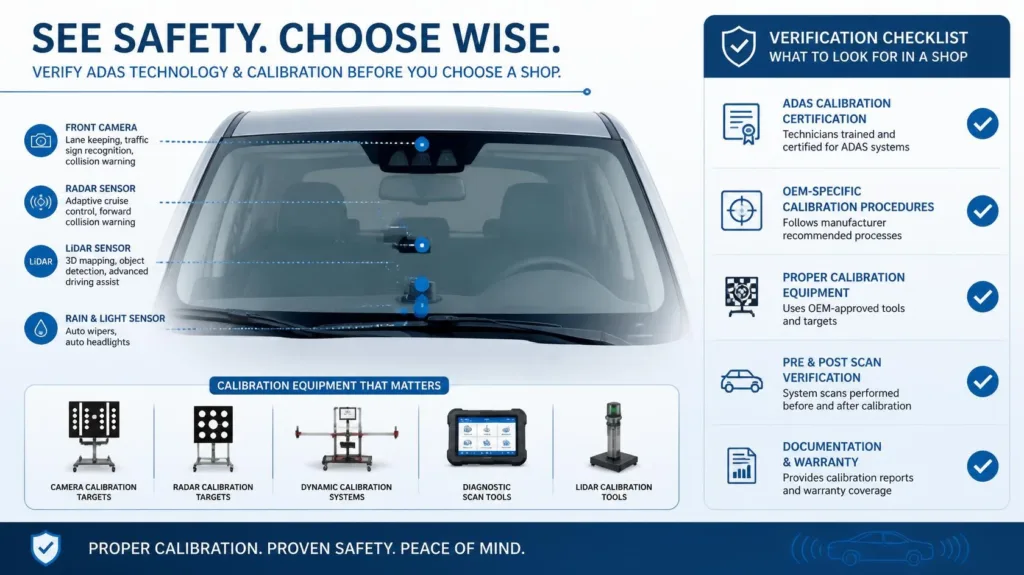
Advanced Driver Assistance Systems (ADAS) are now built into most vehicles from 2020 onward, making modern windshields far more than just a barrier against the elements.
A windshield replacement now means recalibrating cameras, sensors, and radar systems—not just swapping the glass. In fact, ADAS recalibration is mandatory after any windshield replacement to restore full function to safety features like lane-keeping and automatic braking.
Shops must have:
- In-house calibration equipment—not outsourced to a third party
- Factory-grade diagnostic tools compatible with your vehicle’s brand and tech
- Technicians trained to recalibrate systems in hybrids, EVs, and luxury models on-site
A true professional will walk you through their calibration process and show certification for their equipment. Picture this: A top shop calibrates a Tesla, Audi, or Toyota in a dedicated bay, with precision screens and laser-guided alignment—trust is visible at every step.
“If your windshield houses sensors, asking about ADAS calibration is as important as asking about the glass itself.”
—
Diagnostic & Repair Expertise: Ready for Today’s Cars
Not all shops can keep up with the rapid pace of vehicle technology. In 2026, the right provider must prove:
- Access to the most current diagnostic software for 2023–2026 models
- Multi-brand proficiency—they work confidently on SUVs, EVs, hybrids, and imports
- Full understanding of updated repair protocols for advanced platforms
Warning signs:
- Vague answers about recalibration
- No specifics on software tools or recent-model expertise
- Hesitation when asked about hybrid, electric, or specialty vehicles
A reputable shop opens their toolbox and explains each step. An unprepared shop gives vague reassurances—don’t settle for less.
—
How to Vet for Technology-Integrated Repairs
Before you book, ask:
- “Do you include in-house ADAS calibration, and how do you confirm it’s complete?”
- “What diagnostic software do you use for 2026 vehicles?”
- “Can you show proof of recent advanced vehicle repairs?”
Red flags:
- No written guarantee for calibration
- Unwillingness to specify repair protocols
- Offer cash-only deals to avoid insurance (major risk)
Compare leading brands with confidence—visit the Safelite Auto Glass Review and Service Comparison (2026) before choosing.
“Choosing a shop with strong technical capability isn’t extra—it’s essential for your safety and your car’s future resale.”
—
Increasing vehicle complexity isn’t slowing down. Prioritize shops that showcase technical transparency and proven, up-to-date expertise—your safety depends on it.
Quality of Materials and Workmanship: What Sets Top Shops Apart
Type and Certification of Glass
| Glass Type | Safety Rating | Insurer Acceptance | Resale Value Impact | Recommended? |
|---|---|---|---|---|
| OEM Glass (Original Equipment Manufacturer) | High — meets exact vehicle specs | Widely accepted, often required | Preserves value | Yes |
| Certified Equivalent Glass | High — meets or exceeds OEM safety standards | Widely accepted by insurers | Neutral impact | Yes |
| Low-Cost Uncertified Glass | Low — risk of glare, distortion, improper fit | May be rejected by insurers | Can reduce resale value | No |
Selecting the right glass is non-negotiable for safety, clarity, and vehicle integrity. Not all windshields are created equal.
Top shops will always specify the use of:
- OEM glass (Original Equipment Manufacturer): guaranteed fit, meets vehicle specs, and retains vehicle value
- Certified equivalent glass: must meet or exceed OEM safety standards; widely accepted by insurers
- Low-cost, uncertified glass: may cause glare, improper fit, or optical distortion—avoid these for your safety
Picture this: You drive off after a windshield replacement and immediately notice distracting glare or a whistling sound. This is the risk with low-grade glass.
Insurers often require OEM or certified parts for full coverage, and using the wrong type could even affect resale value by failing to meet manufacturer standards.
“Glass quality isn’t just about appearance—it’s central to your safety on the road.”
Installation Procedures and Adhesive Standards
Proper installation is as crucial as glass selection. Precision and process protect you in a collision.
Professional shops will:
- Follow manufacturer-recommended protocols, including proper surface prep
- Use OEM-approved adhesives with documented curing times (typically 1-4 hours for safe drive-away)
- Maintain contamination-free work zones for reliable bonding and leak prevention
Look for technicians using calibrated tools and inspecting the fit; ask about their installation checklist.
“A windshield is a structural barrier, not just a shield from the wind. Shortcuts in installation put your airbag and safety at risk.”
Guarantees and Written Warranties
A reputable shop always provides clear, written warranties.
Key coverage areas include:
- Workmanship and fit: protection against water leaks, wind noise, and improper seals
- Glass defects: including delamination, optical issues, or manufacturer flaws
- Duration: top shops often offer lifetime warranties on installations and at least one year on parts
Ask for a printed summary of what is covered, and look for simple, customer-friendly language—no confusing fine print.
“A written warranty is your confidence card—never settle for just verbal assurances.”
When choosing your auto glass shop, prioritize OEM or certified glass, professional installation standards, and strong written guarantees. These are the essentials that separate trusted experts from risky shortcuts, safeguarding your safety and investment every mile.
Reputation, Reviews, and Industry Recognition
Leveraging Online and Word-of-Mouth Feedback
Before trusting any auto glass repair shop, check their Google and social media reviews closely.
Look for:
- Detailed comments about service speed, ADAS recalibration, and post-repair issues (like water leaks or recurring errors)
- Consistent, long-term satisfaction—not just a handful of 5-star ratings all posted in a single week
A burst of perfect reviews with little detail can mean they’re chasing ratings, not long-term quality.
“If a shop takes pride in fixing ADAS issues the first time, customers will say so—read those comments carefully.”
Ask neighbors, friends, or car enthusiasts in your area; word-of-mouth carries weight, especially for urgent repairs.
Sector Awards and Industry Standing
The best auto glass shops back up their reputation with industry awards and media praise.
Prioritize shops that:
- Are routinely named as “Best of the Year” by trade organizations or local business groups
- Show up in recent media features or on professional platforms (like Infoluna or Infotaller)
- Belong to high-volume specialist brands—big names draw more experience, better supplier relationships, and more training opportunities
A company with years in business and visible sector recognition has likely solved problems like yours before.
“Industry recognition is the silent handshake that says, ‘We do things right, every time.’”
Using Local and National Reviews Effectively
To get granular, balanced insights, check:
- Forums for your city or car model (think Reddit, Facebook groups, or Nextdoor for firsthand experiences)
- National review sites and comparison guides (browse “Low Price Mobile Auto Glass Repair: Fresno Photos & Reviews” or “Speedy Windshield Repair San Diego” for local pros and cons)
When comparing national franchises versus local independents:
- Franchises usually offer national warranties and more robust procedures
- Independents can shine on customer intimacy and faster local support
Picture this: scrolling through photos of newly installed windshields or reading a neighbor’s story about a flawless repair—these stories show you what to expect.
“A reputation built on verified customer stories is your most reliable compass.”
Shops that own their reputation online and offline—from accolades to authentic feedback—send a clear message: your safety and satisfaction matter most. If you use these insights to screen providers, you’re one giant step closer to safe driving and peace of mind.
Insurance Handling, Claims, and Administrative Support
The Role of Insurance in Auto Glass Repair
Most auto insurance policies cover all or most of the cost of glass repair or replacement—meaning many customers pay little to nothing out-of-pocket if they choose the right shop.
Selecting a shop that is an approved partner for major insurers brings immediate benefits:
- Faster approval on repairs thanks to direct relationships
- Streamlined claims filing without paperwork hassles
- Agreed-upon pricing structures that eliminate hidden costs
Picture this: You arrive with a cracked windshield, hand over your policy, and within minutes, the paperwork is handled while you get a text update about your repair status.
“The best shops do the insurance legwork, so you don’t have to.”
Streamlined Claims Processing
Efficient auto glass providers manage every claim step for you, taking care of:
- Submitting repair claims directly to your insurer
- Billing the insurance company, not you
- Communicating with adjusters if needed
Ask these questions before authorizing work:
- “Will you handle all insurance paperwork for me?”
- “Is upfront payment required, or do you bill the insurer directly?”
- “How long does the typical claim approval take?”
Shops that skip steps, ask for cash upfront, or offer vague claim explanations are warning signs you shouldn’t ignore.
“A truly professional shop will never leave you chasing reimbursements or deciphering insurance forms on your own.”
Avoiding Administrative Headaches
Keep your experience hassle-free by:
- Choosing shops that guarantee direct billing to your insurance
- Avoiding providers who push paperwork or advance payment burdens onto customers
- Confirming that you will receive written confirmation of all insurance interactions—including claim numbers and payment status
Look for shops that assign you a dedicated advisor for updates, faster answers, and follow-through. Disorganized admin support can delay repairs by days or even weeks.
If you see unclear processes, pushbacks about billing, or evasive answers—walk away before the headaches begin.
From first call to final paperwork, a trustworthy shop keeps you informed, takes ownership of insurance communication, and puts your convenience first. When the admin runs smoothly, your focus can stay where it counts: clear vision and safe driving.
Transparency in Pricing, Process, and Recommendations
Obtaining and Understanding Written Estimates
A clear, detailed written estimate is non-negotiable when choosing an auto glass repair shop in 2026.
Every trustworthy quote should spell out, line by line:
- Glass type and brand (OEM or certified equivalent)
- ADAS calibration inclusion (crucial for safety with modern vehicles)
- Labor charges and any extra fees (like moldings, disposal, or cleaning)
- All services included, with no hidden costs
Seeing all items in writing protects you from unexpected add-ons and builds lasting trust.
Did you know some shops still avoid written quotes? This is a red flag—88% of leading industry guides recommend written documentation before any work begins.
Picture this: You receive a digital quote showing the glass brand and a note: “Includes ADAS recalibration—factory protocol followed.” That’s the transparency top-tier shops now deliver.
“Written estimates serve as your protection and proof—never start work without one.”
—
Ethics: No-Pressure Sales and Repair vs. Replacement Honesty
Transparent auto glass shops keep sales pressure out of the process.
Beware of these scenarios:
- The initial price is oddly low, but suddenly there are surprise upcharges
- Staff nudge you toward cash-only deals (“we’ll do it cheaper off the books”) or suggest skipping insurance
- The shop pushes for replacement when a small repair would be safer, faster, and more cost-effective
Ethical providers will:
- Explain when repair is possible and when replacement is necessary, based on crack size, location, and visibility impact
- Clearly state insurance-related options—no pressure, just facts
“A professional will always tell you what’s safest, not what’s most profitable.”
—
Red Flags for Non-Transparent Practices
Watch for classic warning signs indicating lack of transparency:
- Bait-and-switch pricing (the price changes after you drop off the car)
- Refusal or reluctance to put details in writing
- Vague answers about what glass or protocols they use
- Confusing explanations or resistance to basic questions
In 2026, honesty is a hallmark of reputable shops—and protecting your family’s safety is too important for shortcuts.
“If you feel rushed, pressured, or uncertain, walk away—you deserve straightforward answers at every step.”
—
A written, itemized quote and straightforward communication set the benchmark for trust in auto glass repair. If a provider can’t answer direct questions or hesitates to document their promises, keep searching. True professionals value transparency as much as safety—clear vision, safe driving, and total confidence should always come standard.
Customer Service Excellence and Clear Communication
Personalized Service and Consistent Points of Contact
A truly professional auto glass shop assigns you a dedicated advisor—a single person who knows your repair from start to finish.
This one-on-one approach means you’re never lost in the shuffle or left waiting for answers.
Expect:
- Direct contact information for questions or concerns—no frustrating call transfers.
- Regular updates via text, email, or phone about your repair progress, delays, and next steps.
- One clear face behind every interaction—building trust and accountability.
“A dedicated advisor handles your vehicle as if it’s their own—so you never feel like just another ticket in the system.”
Clarity, Honesty, and Accessibility
Great shops make complex repairs easy to understand. They explain:
- The difference between repair and full replacement—sharing safety implications for each.
- Whether your glass requires ADAS calibration or other specialized steps.
- Timings, pricing, and options in clear, upfront language—no surprises, no jargon.
Look for:
- Extended hours beyond 9-to-5, plus weekend or after-hours availability for urgent needs.
- Online booking portals and instant chat support, making appointments hassle-free.
- Digital status tracking so you know exactly when your car will be ready.
“If you leave with more questions than answers, it’s not the right shop.”
Handling Special Situations and Emergencies
When cracks happen unexpectedly, top providers respond fast.
Modern leaders offer:
- 24/7 crisis support for situations like shattered windshields or failed sensors.
- Same-day appointments for chips or urgent glass replacement—often fixing minor issues in under 30 minutes.
- In extreme cases, mobile units that come to your location so you can get back on the road safely and quickly.
Picture this: your windshield cracks on a holiday, but a mobile technician arrives within hours—rebuilding your confidence as well as your glass.
“Speed and compassion set great service apart in emergencies.”
____
The right shop delivers clear, honest updates and seamless support—from first call to final inspection. Prioritize providers who treat your safety as their top priority and never leave you guessing.
Convenience: Location, Scheduling, and Service Options
Evaluating Shop Accessibility and Mobility Solutions
When it comes to auto glass repair in 2026, convenience is a major deciding factor.
For busy drivers and business owners, a shop’s proximity and network size can mean the difference between same-day service and extended downtime.
- Look for shops with multiple locations or a wide service network—these often offer faster response times.
- Ask if they provide mobile repair units that come to your home or workplace, reducing the need for a second trip.
- Some top providers offer courtesy vehicles or comfortable waiting areas, helping you stay on schedule even during unexpected repairs.
“Choose a shop that fits your life, not one you have to fit your life around.”
Picture this: You discover a crack in your windshield before work. With the right shop, you can have a technician at your driveway before your morning coffee is done brewing, or drop off your car and grab a courtesy car for the day.
Flexible Scheduling and Realistic Timelines
Flexible scheduling is now the norm for leading auto glass shops.
- Expect online booking systems with real-time slot availability, automatic reminders, and status updates by SMS or email.
- Typical repairs range from 30 minutes for chip repairs to 2–4 hours for complete replacements, especially if ADAS recalibration is involved.
- For late-model vehicles with synced sensors, plan for additional time—some 2026 models require up to an hour for full ADAS system checks.
“Smart shops use technology to make your downtime nearly invisible.”
If a shop can’t clearly explain their appointment process or hesitates when asked about ADAS calibration, consider it a warning sign.
City-Specific Solutions
Your choices may shift based on where you live or work.
- Urban areas often have both brick-and-mortar shops and mobile fleets ready to assist on-site.
- Regional providers sometimes specialize in quick-response teams for fleet owners or remote areas.
For hands-on comparisons, check detailed local guides like the “Pacific Auto Repair Body Shop Glass & Towing: 2026 Guide” or the “Speedy Windshield Repair San Diego: Reviews & Comparison.”
“Your location shouldn’t limit your vision—or your safety.”
In every scenario, the best shop offers service options tailored to your real-world schedule. Prioritizing a provider that matches your life’s pace and geography can mean the difference between a seamless fix and a stressful one—choose convenience that doesn’t compromise safety or quality.
Facility Standards, Cleanliness, and Professional Image
Assessing Shop Organization and Cleanliness
A clean, organized shop isn’t just cosmetic—it’s a sign of real commitment to safety and professionalism.
Look for these essentials during a visit (in person or via photos):
- Tidy service bays with tools stored in cabinets, not strewn on the floor
- Clearly labeled storage zones for new and used glass
- No clutter or spills in customer waiting areas
- Marked pathways and safety signage visible to all
Picture this: You step into a shop with gleaming floors, every tool in its place, and windows so sparkling you can see your reflection—it’s impossible not to feel confident in their precision.
“A spotless auto glass shop speaks volumes about how they’ll treat your car.”
Specialized Work Areas and Documentation
Specialized services demand dedicated spaces. Any reputable shop should show clear evidence of:
- Dedicated calibration zones for handling ADAS-equipped vehicles
- Contamination-controlled glass installation areas (free from dust and moisture)
- Walls displaying current certificates, permits, and technician credentials (including NIF, training credentials, manufacturer authorizations)
Ask yourself: Would you trust your safety to a provider who tucks their certifications out of sight?
“Seeing technician training documents and calibration equipment out in the open is your reassurance that this team is playing by the rules.”
The Role of a Professional Image in Building Trust
First impressions stick. When a shop’s branding, uniforms, and workspace are consistently crisp and modern, it sends a powerful message:
- Branded attire and vehicles reflect reliability
- Clear signage indoors and out signals transparency
- Digital and printed estimates featuring recognizable logos reinforce professionalism
Visual walkthrough: Imagine a team member greeting you in a branded blue shirt, walking you past a glass installation station with clear company logos and safety posters—trust comes naturally.
“A professional image, from front desk to back room, is non-negotiable for anyone prioritizing safety and clarity.”
—
For anyone comparing shops, focus on visible signs of order, credentials, and brand pride. In 2026, a facility that looks and feels professional is your best guarantee that your auto glass—and your safety—are top priorities.
Practical Comparison Framework: How to Compare Auto Glass Shops
Using a Comparison Grid for Objective Decision-Making
Choosing the right auto glass repair shop shouldn’t feel overwhelming—a comparison grid puts you in control.
Break your shortlist down using these decisive criteria:
- ADAS calibration capabilities: Does the shop explain how they handle your vehicle’s advanced safety systems?
- Material quality: Are you offered OEM or certified glass? Which brands do they use?
- Warranty terms: Look for clear, written guarantees covering installation, leaks, and glass defects.
- Reputation and reviews: What do customers say about fit, ADAS issues, or claim handling?
- Insurance support: Does the shop handle claims or make you pay upfront?
- Transparency of pricing: Are you given a detailed, written estimate?
- Customer service: Is there a single contact and consistent communication?
- Convenience: Consider location, mobile service, and average timeline for repair.
Create a simple grid—rate each shop on these factors from 1 to 5 as you gather answers.
Picture this: You’re in the shop, grid in hand, asking, “How will you calibrate my ADAS after replacing the glass?” Their answer—and whether they can show you their calibration area—speaks volumes.
“A good shop makes their process visible and their answers specific, not generic.”
—
Interpreting Shop Responses and Focusing on What Matters Most
Not every criterion should weigh equally.
- Prioritize ADAS calibration, warranty, and glass quality—these impact both safety and the long-term value of your vehicle.
- Give more weight to reputation and insurance support if you want peace of mind and easy claims.
If two shops seem close, always choose the one with:
- Transparent process explanations
- More detailed warranty terms
- Several positive reviews mentioning ADAS or insurance
“When undecided, ask yourself: Would I trust this shop with my family’s car?”
—
Customizing the Comparison to Fit Your Specific Needs
Tailor your checklist to match your vehicle and situation:
- For a 2024 EV with lane-keeping assist, ask about experience with recalibrating specific ADAS systems.
- For fleet owners or dealerships, check if the shop accommodates multiple vehicles and tight timelines.
- If your insurer requires partner shops, confirm direct billing and claims management.
Use digital tools and shop comparison pages for up-to-date info and sample questions.
“Matching your car’s features to a shop’s strengths is the fastest way to a safe, smooth repair.”
Keep your grid handy and review it before you commit. Clarity, documentation, and honest answers matter most—they’re your guarantee of clear vision and safe driving, every time.
Warning Signs and Red Flags to Avoid
Major Risk Factors in Choosing an Auto Glass Provider
Choosing the wrong shop can put your safety—and your wallet—at risk.
Watch for these major red flags before committing:
- No written estimate or attempts to skip official documentation
- Evasive answers about ADAS calibration or failure to specify what glass will be used
- Mysterious pricing or shops pushing for cash deals to avoid insurance involvement
- Sparse, negative, or suspiciously uniform reviews online, especially when credentials aren’t displayed
- Refusal to provide a clear warranty (both on work and materials) or explain the installation process step by step
A recent survey found that nearly 1 in 3 costly auto glass mistakes traces back to unclear estimates or unqualified shops. If a provider can’t clearly state their process, safety standards, or product sources—consider it a flashing warning light.
“If it feels rushed, vague, or ‘too good to be true,’ it probably is.”
—
When to Walk Away
Knowing when to say “no” is just as important as knowing when to say “yes.”
Here’s a quick walk-away checklist:
- The shop will not give you anything in writing.
- Staff won’t or can’t explain ADAS recalibration procedures or claim it’s not needed for your car.
- They can’t specify whether the glass is OEM or certified equivalent.
- The shop pushes for cash payments and discourages insurance involvement.
- There’s a pattern of poor reviews, unaddressed complaints, or zero independent online reputation.
- You feel pressured or sense hesitation about explaining their warranty or process.
Picture this: You visit a spotless, professional-looking facility—but staff dodge basic questions or steer all pricing “off the books.” Trust your instincts and don’t hesitate to check two more providers.
“Your safety on the road is worth the extra call or click.”
—
Building Confidence in Your Final Choice
Before green-lighting a repair or replacement, ask yourself:
- Have you received a written estimate outlining glass, labor, and ADAS calibration?
- Is the provider clear about the warranty and their process—for both installation and future issues?
- Did you read at least five detailed reviews mentioning ADAS alerts, leak checks, or customer care?
- Does the shop answer every question with confidence and transparency?
Need more help? Try a diagnostic comparison tool or checklist (linked on our service comparison subpages) to rate your options side by side.
The right shop will welcome your questions and demonstrate clear value at every step. Use this framework to filter out pretenders—and only trust your auto glass repair to verified professionals who take your safety seriously.
our Roadmap to a Safer, Smarter Repair Choice
Choosing the right auto glass repair shop isn’t just a routine decision—it’s a fundamental investment in your safety, your car’s future value, and your own peace of mind. By insisting on professionalism, clarity, and expert standards, you ensure every mile you drive is backed by visible quality and invisible protection.
Focus on these decisive actions to secure lasting results and confidence on the road:
- Demand a detailed, written estimate—including ADAS calibration and glass type—before any work begins.
- Ask pointed questions about technician training, in-house calibration, and warranty coverage to expose genuine expertise.
- Verify the shop’s credentials and reputation by checking for recent reviews, real customer stories, and industry recognition.
- Never be rushed—walk away from unclear processes, vague pricing, or pressure to skip insurance involvement.
- Prioritize providers offering dedicated advisors, real-time updates, and mobile or flexible service that fits your actual schedule.
Take the next step: download or create a comparison checklist and call your top two shops today—see how their answers stack up. Request a facility tour, proof of calibration, and warranty details in writing. Bring these standards to every conversation—you’ll gain clarity and set the bar for safe, effortless auto glass repair.
Your drive deserves uncompromised safety and total transparency. When you demand clear answers and quality at every stage, you’re not just repairing glass—you’re protecting your future on the road.
“Clear vision leads to safe driving—choose the shop that gives you both.”
FAQ
- How do I choose the right auto glass repair shop for ADAS-equipped vehicles?
Look for a right auto glass repair shop with in-house calibration equipment, factory-grade diagnostic tools, and technicians trained on 2020-and-newer models. - What should a written estimate from a right auto glass repair shop include?
A trustworthy right auto glass repair shop provides a line-by-line quote covering glass type, ADAS calibration, labor, and any extra fees before work begins. - Does the right auto glass repair shop handle insurance claims directly?
Yes — the right auto glass repair shop typically bills insurers directly, files claims paperwork, and communicates with adjusters so you avoid hassle. - How long does a windshield replacement take at the right auto glass repair shop?
Most replacements at the right auto glass repair shop take 2–4 hours, with additional time needed when full ADAS system checks are required. - What warranty should I expect from the right auto glass repair shop?
A dependable right auto glass repair shop offers a written lifetime workmanship guarantee and at least a one-year warranty on materials.
Thank you for choosing Discount Auto Glass. Fast, reliable service with a lifetime guarantee. Visit us or enjoy our mobile service.