June 20, 2026
Auto Glass Repair Safety Standards and Best Practices
For anyone relying on their vehicle’s safety and longevity, understanding auto glass repair safety standards and best practices is essential. The following highlights empower you to make confident decisions, ensuring durable repairs, compliance, and the well-being of every passenger.
- Federal safety standards matter—FMVSS regulations require windshields to support up to 60% of your car’s roof strength and ensure glass stays intact during crashes, protecting lives in rollovers and impacts.
- Only trust DOT-approved, OEM-spec glass—Look for a DOT mark and ANSI/AGRSS certification to guarantee your replacement meets or exceeds original factory safety standards.
- Choose AGSC-certified technicians—Insist on certified professionals using an 11-point quality checklist for precision, structural integrity, and full warranty coverage.
- Replace when damage exceeds safe limits—Chips larger than 1 inch or cracks over 12 inches demand immediate replacement; smaller repairs are only safe outside your direct line of sight.
- Always document your repair—Request written proof including DOT markings, technician credentials, and AGRSS compliance for warranties and insurance audits.
- Legal compliance protects you—Ignoring standards can result in voided insurance, failed inspections, and lawsuits—especially for fleet owners or dealerships.
- Prioritize aftercare for safety—Avoid car washes and temperature extremes the first 24–48 hours after repair to ensure adhesives cure properly and maintain long-term protection.
- Demand clear communication—A transparent, step-by-step repair process with a focus on customer education is your best defense against unsafe, low-quality fixes.
With these proven practices, you can drive confidently knowing your auto glass is repaired safely and professionally. Ready to learn more? Dive into the full guide for step-by-step details and expert tips.
Why Your Windshield Is Your Vehicle’s Most Critical Safety Shield
A single cracked windshield can quickly turn from a minor hassle into a major threat—did you know your auto glass is responsible for up to 60% of your vehicle’s roof strength during a rollover?
It’s easy to underestimate just how crucial professional auto glass repair is for your safety, but the risks of shortcuts are real. From airbag function to cabin protection in a crash, even the smallest detail matters.
When you choose a repair shop, you’re not just fixing glass—you’re investing in the safety, reliability, and value of your entire vehicle.
Wondering what separates a quick patch from a repair you can trust? The difference is visible—in how certified technicians work, in the quality of materials they use, and in the standards they uphold. At Discount Auto Glass, every repair is built on:
- Industry-leading safety standards that meet or exceed federal and state requirements
- Meticulous processes from material selection to aftercare guidance
- Clear communication—so you understand every step and feel confident behind the wheel
For drivers, fleet owners, and dealerships, understanding what goes into a safe, compliant auto glass repair pays dividends: stronger safety, better insurance protection, and fewer costly surprises down the road. With transparency and expert guidance, you protect what matters most—your peace of mind and your passengers.
Curious about the rules and best practices that ensure every repair meets the highest mark? Let’s take a closer look at the invisible standards behind every safe pane of glass—and discover how you can keep your vehicle road-ready for every journey ahead.
Understanding Auto Glass Repair Safety Standards
Why Safety Standards Matter
Auto glass safety standards serve as the invisible shield that protects everyone on the road.
Properly installed and certified auto glass doesn’t just keep wind and debris out—it supports up to 60% of your car’s roof strength during a rollover.
Imagine a traffic accident: correct glass installation can mean the difference between the airbags working as designed, or catastrophic cabin collapse.
These standards are the foundation for long-term reliability and customer trust, making safety non-negotiable.
“A properly installed windshield is your car’s most critical piece of safety equipment after your seatbelt and airbags.”
The Four Key FMVSS Requirements
Federal guidelines, enforced by the NHTSA, form the gold standard for every auto glass installation in the U.S.
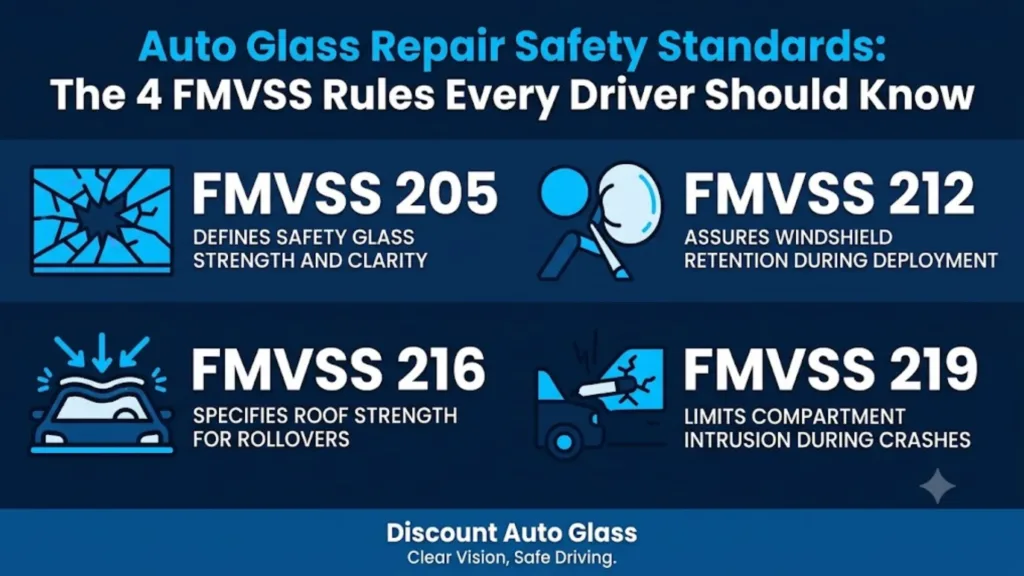
The Federal Motor Vehicle Safety Standards (FMVSS) cover:
- FMVSS No. 205: Demands glass meet strict rules for strength, transparency, and impact resistance—replacement glass must always match or exceed the original.
- FMVSS No. 212: Ensures windshields stay in place during frontal impacts, critical for airbag function and preventing ejection.
- FMVSS No. 216: Your windshield helps prevent roof caving in rollovers—a major factor since rollovers cause over 9% of all vehicle accidents.
- FMVSS No. 219: Keeps the windshield from intruding into occupant space during a collision.
Picture this: An unapproved windshield could shatter or detach, putting you and your family at real risk in a split second.
INSERT AFTER: “Picture this: An unapproved windshield could shatter or detach, putting you and your family at real risk in a split second.”
| FMVSS Standard | What It Governs | Why It Matters to You |
|---|---|---|
| FMVSS No. 205 | Glass strength, transparency, and impact resistance | Your replacement glass must match or exceed factory specs — no cutting corners |
| FMVSS No. 212 | Windshield retention during frontal impacts | Keeps glass in place so airbags deploy correctly and occupants stay inside |
| FMVSS No. 216 | Roof crush resistance during rollovers | Your windshield carries up to 60% of roof load — a weak install puts lives at risk |
| FMVSS No. 219 | Windshield intrusion into occupant space | Prevents glass from collapsing inward and injuring passengers during a crash |
Industry and Testing Benchmarks
Beyond federal rules, the industry uses strict benchmarks to guarantee safety, durability, and clarity.
The pillars here:
- ANSI Z26.1: Twenty glazing types, thirty-one real-world tests—this standard defines what “tough enough” really means for auto glass.
- DOT Certification: Every legal windshield has a “DOT” mark etched on it, your proof it’s tested, not counterfeit or reused.
- AGRSS Compliance: The Automotive Glass Replacement Safety Standard lays out the safest installation steps and requires ANSI-accredited training—mandated by law in states like Maryland.
Next time you see a gleaming new windshield, remember: its strength lies in invisible certifications and rigorous test results.
A smart takeaway: Always check for DOT markings, demand certified installers, and ask about compliance with AGRSS. These quick checks put you in control of your safety and your car’s future—because at Discount Auto Glass, “Clear Vision, Safe Driving” is never optional.
Best Practices for Safe Auto Glass Repair and Replacement
Glass and Adhesive Quality Standards
Choosing the right glass and adhesive is the foundation of safe auto glass repair. Always insist on OEM-spec laminated or tempered glass with a DOT approval mark to guarantee that your replacement matches or exceeds factory safety standards.
Using adhesives that meet or exceed original manufacturer specifications isn’t just a preference—it’s a safety requirement. High-performance urethane adhesives, when properly applied, help ensure the windshield provides up to 60% of the structural support in a rollover, a factor critical to accident survivability.
Inferior or non-compliant materials can shatter unexpectedly or fail in a crash, putting everyone at risk. Picture this: your windshield holding firm thanks to a professional high-strength adhesive, even if the unthinkable happens on the road.
Professional Installation Protocols
A safe auto glass repair is all about precision, professionalism, and process. Certified technicians—AGSC or AGRSS trained—use proven methods that deliver reliable results every time.
Key steps in the 11-Point Quality Checklist include:
- Initial inspection and full protection of your vehicle’s interior
- Complete removal of the old adhesive (full cut-out, down to 1/16 inch)
- Precision application of urethane, observing safe drive-away times based on temperature/humidity
- Cleaning, vacuuming debris, and checking critical systems (wipers, sensors)
- A comprehensive final inspection and clear review of your repair warranty
Every step, from inspection to warranty review, ensures your vehicle’s structural integrity and your peace of mind.
Recognizing Qualified Service Providers
Not all shops are equal—choose only those with AGSC certification or AGRSS registration to guarantee safety and compliance.
Look for:
- Certifications visibly displayed in-shop or online
- Consistently positive customer reviews mentioning safety and satisfaction
- Shops that provide written warranties and thoroughly explain repair processes
Partner with providers who prioritize safety, practice transparency, and protect your investment. The difference between a quick fix and a quality repair can mean safer travels for years to come.
A little diligence today—choosing verified materials and certified technicians—is the best investment in your clear vision and safe driving. Trust professionals who treat your safety as their highest responsibility.
Repair vs. Replacement: Safety-Centered Decision Making
Evaluating Damage Type and Scope
Not all windshield damage is equal—the size, depth, and location of chips or cracks determine the right course of action.
Use these industry-standard thresholds as your safety guide:
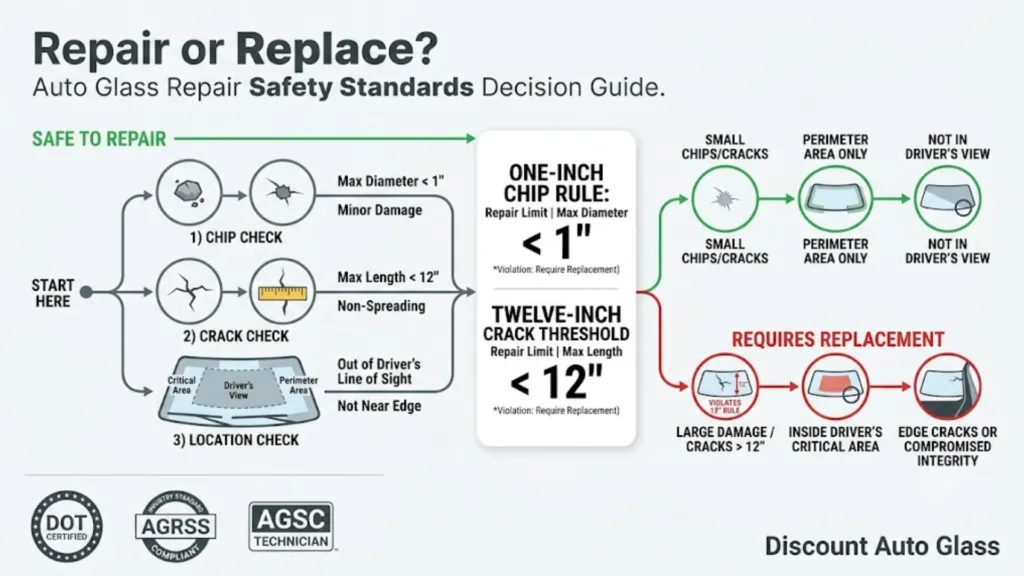
- Chips larger than 1 inch or cracks longer than 12 inches (about the length of a dollar bill) require immediate replacement.
- Smaller chips (≤1 inch) and limited cracks (≤12 inches) can often be safely repaired if they’re outside the driver’s line of sight.
- Damage in corners, at the edge, or in critical sensor zones is more likely to require full replacement for optimal safety.
Picture this: A small chip left unaddressed can quickly spider into a foot-long crack with just one rough bump or sudden temperature swing.
Techniques for Safe Repair
Professional repair isn’t just about filling glass—precision and proper tools make all the difference.
Here’s how it works:
- Clean the area to prevent contamination and ensure a clear bond.
- Inject a high-quality resin into the chip or crack, restoring strength and clarity.
- Apply controlled heat to cure the resin, hardening it for maximum durability.
Choosing DIY kits over trained technicians can result in weak repairs, visual distortion, or incomplete sealing—all of which compromise your safety and warranty coverage.
“Even a perfect-looking repair can become a hidden hazard if not done to OEM standards.”
Risks of Improper Repair vs. Replacement
Getting it wrong has serious consequences:
- Unrepaired or poorly repaired glass can shatter during accidents, putting everyone inside at risk.
- Insurance may deny claims for damages made worse by unprofessional repairs.
- Vehicle inspections (and resale value) may flag or reject visible flaws or non-compliant fixes.
One overlooked crack today can become a major liability tomorrow.
Key Takeaways for Drivers and Fleet Owners
- When in doubt, choose professional assessment over guesswork—safety first, always.
- Don’t ignore even minor chips; quick repairs save time, money, and prevent bigger safety risks.
- Always insist on OEM-spec glass and certified technicians to protect your investment and your passengers.
Your repair decision isn’t just about looks—it’s about preserving the structural integrity and resale value of your vehicle while ensuring peace of mind on every drive.
Compliance and Legal Considerations
Ensuring Regulatory Compliance
Auto glass repair isn’t just about safety—it’s about legal responsibility.
Across the U.S., Federal Motor Vehicle Safety Standards (FMVSS) set the baseline, but several states raise the bar by making the Automotive Glass Replacement Safety Standard (AGRSS) law—for example, Maryland enforces these standards statewide.
If a shop fails to comply:
- Customers risk voiding their vehicle warranty or insurance coverage.
- Shops may face fines, lawsuits, or loss of licensing.
- Vehicle inspections can be failed due to non-compliant or counterfeit glass.
Proper documentation is critical. Always ask for a written record of the repair, including:
- DOT glass markings
- Technician certification and AGRSS/ANSI compliance notes
- Receipts for insurance or audit purposes
Picture this: A fleet owner in a state with AGRSS as law keeps digital records after each repair—saving thousands if an insurance audit hits.
Safety, Insurance, and Liability
Insurance companies check for compliance before honoring claims.
If your auto glass repair provider skips recognized standards or uses unapproved materials, you can lose critical coverage after a collision or damage.
Choose shops that provide:
- Transparent warranty terms
- Documentation showing use of DOT-approved glass and certified adhesives
- AGSC or AGRSS credentials on display
Avoiding “quick fix” providers can protect you from expensive legal or safety consequences later.
“Trust is visible in every detail—from the glass markings to the paperwork you receive.” (Shareable quote)
Fleet, Dealership, and Commercial Considerations
Fleet operators and dealerships must meet higher compliance demands due to volume and liability concerns.
This means:
- Regular compliance audits
- Strict recordkeeping for each repair or replacement
- Transparent processes to prevent counterfeit or reused glass
For commercial fleets, following these standards keeps vehicles on the road, reduces risk, and passes insurance checks—protecting both assets and reputations.
By prioritizing compliance, you not only meet regulations but secure long-term confidence, safety, and insurance coverage. Choosing providers who operate with clarity and integrity ensures you always pass the test, on the road and on paper.
Post-Repair Safety Protocols and Customer Guidance
Immediate Aftercare (First 24–48 Hours)
Your new auto glass needs time to cure for long-lasting safety and performance.
Picture this: you’re driving away from the shop—resist the urge to wash your car or remove any tape right away. For the first 24-48 hours, always:
- Avoid car washes, power spraying, or high-pressure hoses (water can weaken uncured adhesives)
- Skip rapid temperature swings (no defrosters or blasting A/C right on the glass)
- Drive gently and use surface streets when possible
- Crack windows slightly—this helps equalize pressure and prevents leaks
- Leave tape and warning labels in place until approved by your technician
A single, early car wash can undo professional work—so make these simple steps a non-negotiable part of your aftercare.
Ongoing Inspection and Maintenance
Long-term clarity and structural safety rely on proactive upkeep.
Within the first few weeks, and regularly after, inspect your glass for:
- New chips, small cracks, or distortion, especially after potholes or rock strikes
- Dust and debris along seals—keep edges clean with gentle, approved cleaners only
- Adhesive shifts or leaks—listen for wind noise or feel for moisture after rain
Only use glass-safe, ammonia-free cleaners for a streak-free shine and to avoid damage to coatings or adhesives.
Reporting issues early keeps warranties valid and can mean the difference between a quick fix and costly replacement.
The Value of Transparent Communication and Customer Education
Imagine you’re at the shop—your technician walks you through every step, showing exactly where repairs were made and sharing insights for ongoing care.
Ask these questions after repair:
- What’s covered under my repair or replacement warranty?
- Which warning signs should I look for over the next month?
- How do I contact the shop if I spot any issues or need a touch-up?
Clear communication builds trust and reassures you that your safety is always the top priority. When you understand every part of the process, there are no surprises—only safe driving and peace of mind.
When it comes to auto glass, the smallest habits after repair protect your investment, your warranty, and your safety on every drive. Take each aftercare step seriously, and enjoy the reassurance of knowing your vehicle is road-ready and secure.
Drive Forward With Confidence — Your Safety Standard Starts Here
Choosing auto glass repair isn’t just a matter of convenience—it’s a crucial investment in your safety and peace of mind.
With the right standards, certified professionals, and clear aftercare, you ensure every mile ahead is as secure as it is clear.
To protect what matters most on the road, remember these key actions:
- Verify certifications: Always check for DOT markings and confirm your technician’s AGRSS or AGSC qualifications.
- Insist on OEM-spec materials: Demand only high-quality, compliant glass and adhesives—never compromise on structural integrity.
- Get clear documentation: Request detailed records of every repair for warranty, insurance, and your personal assurance.
- Follow aftercare precisely: Respect recommended cure times, avoid early car washes, and ask questions before leaving the shop.
- Stay vigilant: Inspect for new chips, leaks, or distortion—early attention now prevents expensive fixes later.
Ready to take charge of your auto glass safety? Start by booking a professional assessment, reviewing your last repair documentation, or asking your provider about their compliance and warranty policies.
Prioritize your safety—don’t leave it in someone else’s hands.
Your clear vision leads to safe driving, every single day. When you partner with professionals who treat safety as their highest standard, you not only protect your vehicle—you protect every journey ahead.
Trust is visible in every detail, from the way your glass is installed to the confidence you feel behind the wheel. Elevate your safety standards today—and drive forward knowing you’ve set the bar for everyone else on the road.
FAQs
- What are auto glass repair safety standards and why do they matter?
Auto glass repair safety standards are federally and industry-mandated guidelines — including FMVSS, AGRSS, and ANSI Z26.1 — that ensure your windshield provides structural support, maintains airbag function, and keeps occupants protected during rollovers and collisions. Without meeting these standards, even a visually clean repair can be a hidden safety hazard. - How do I know if a repair shop follows auto glass repair safety standards?
Look for AGSC certification, AGRSS registration, and DOT-marked glass displayed or documented at the shop. A compliant provider will offer written warranties, show technician credentials, and walk you through their repair process step by step — all hallmarks of a shop that genuinely upholds auto glass repair safety standards. - When does damage require replacement under auto glass repair safety standards?
According to auto glass repair safety standards, chips larger than one inch or cracks exceeding twelve inches require full replacement. Damage located in the driver’s direct line of sight, near edges, or in sensor zones also typically demands replacement rather than repair to preserve structural integrity and legal compliance. - Can non-compliant repairs void my insurance under auto glass repair safety standards?
Yes — insurance companies actively check whether repairs align with recognized auto glass repair safety standards before honoring claims. Using unapproved materials, uncertified technicians, or skipping required documentation can result in denied coverage, failed vehicle inspections, and even legal liability for fleet owners and dealerships. - What aftercare is required to maintain auto glass repair safety standards after replacement?
To preserve the integrity guaranteed by auto glass repair safety standards, avoid car washes, high-pressure spraying, and extreme temperature changes for the first twenty-four to forty-eight hours after installation. Leave protective tape in place until your technician approves removal, drive gently, and crack windows slightly to equalize cabin pressure while adhesives fully cure.
Thank you for choosing Discount Auto Glass. Fast, reliable service with a lifetime guarantee. Visit us or enjoy our mobile service.