
May 26, 2026
Auto Glass Repair Costs and Insurance Guide 2026
Navigating auto glass repair costs and insurance in 2026 doesn’t have to be complicated. Here’s your rapid, expert-backed summary to help you make safe, cost-effective decisions with confidence, whether handling minor chips or high-tech glass replacements.
- Know typical repair and replacement costs: Expect chip repairs at $50–$120 and standard windshield replacements from $250–$800+, with ADAS-equipped vehicles reaching $2,000+ for OEM glass.
- Insurance coverage can mean $0 out of pocket: Most comprehensive policies offer free chip repairs and may cover replacements minus your deductible—verify your deductible and ask about glass riders for maximum savings.
- Act fast—small repairs prevent big bills: Fix chips and cracks immediately to avoid a minor $70 repair turning into a costly $700+ replacement and potential safety risks.
- State laws impact your glass claim: In places like Illinois, insurers cannot raise your premium solely for glass claims, but other states may require full deductibles—always check local rules before filing.
- Multiple small claims may raise premiums: While your first glass claim is often “forgiven,” repeated claims can trigger higher rates or coverage changes—assess your claims history before submitting.
- Professional shops streamline claims and safety: Choose certified providers that handle insurance paperwork, ensure proper ADAS recalibration, and offer strong warranties for peace of mind.
- DIY kits are only safe for minor, non-critical chips: Limit DIY repairs to chips smaller than a quarter and never for ADAS, heated, or panoramic glass—professional repairs offer higher success and lasting safety.
- Documentation and clear communication are essential: Save all repair invoices and insurance details; reputable shops provide transparent quotes and proof of work for every job.
For a crystal-clear breakdown on pricing, coverage options, and choosing the best provider, dive into the full guide—protect your safety, your budget, and your clear vision on the road.
What Every Driver Should Know
A stray pebble cracks your windshield on a busy highway—what comes next might cost you $60, $1,600, or even spark a call to your insurance agent before the day is out.
Sound familiar?
With the average windshield replacement now ranging from $250 to $800—sometimes topping $2,000 for newer models—it’s no surprise that finding clear answers (and real savings) is more important than ever.
Untangling auto glass repair costs and insurance coverage can feel overwhelming, especially as vehicles get smarter and insurance rules change each year.
But here’s what you need to know:
The right information protects not just your budget, but your safety behind the wheel.
In this up-to-date guide, you’ll discover:
- What repairs and replacements really cost in 2026, whether it’s a chipped window or shattered panoramic glass
- How insurance coverage works—including exactly when your claim pays, how deductibles affect your bill, and what to ask before filing
- Tips to keep your out-of-pocket costs low, from understanding $0-deductible repairs to getting the most from every claim
- How state laws and choosing the right shop can make the difference between a budget fix and a costly headache
Picture yourself driving away with total clarity—no hidden fees, no surprises, confidence that your repair meets the highest safety standards.
It’s time to get clear on pricing, insurance, and the smart steps that protect your visibility and your wallet.
Here’s what you need to know first: exactly how much to expect for common repairs and replacements, plus the key cost drivers every vehicle owner should watch.
Typical Costs for Auto Glass Repair and Replacement
Choosing the right time to repair or replace auto glass starts with knowing the real numbers. In 2026, most chip or crack repairs fall between $50–$120 across the U.S.—a quick fix you can usually get same day.
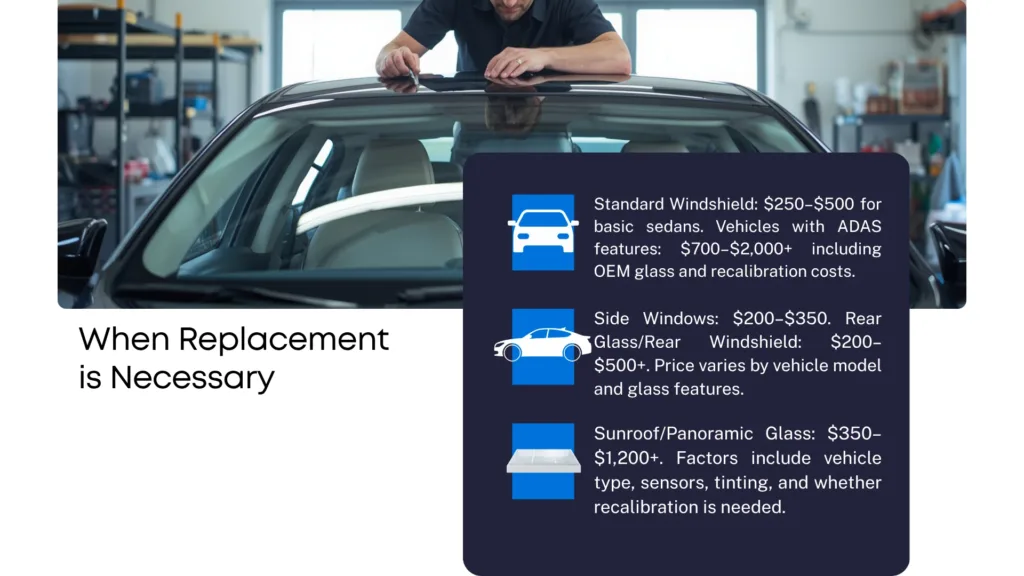
A standard windshield replacement on a sedan runs about $250–$500 (no special features), but many vehicles land in the $250–$800+ range, depending on model, glass type, and extras. High-end cars or those with ADAS (Advanced Driver Assistance Systems) can see bills from $700 up to $2,000+, especially when using OEM (Original Equipment Manufacturer) glass.
Picture this: a 2023 Toyota Sequoia may cost $1,600 (aftermarket) or $2,400 (OEM) just for the windshield—before tax or recalibration. If your glass includes heating, tinting, or sensors, expect a premium.
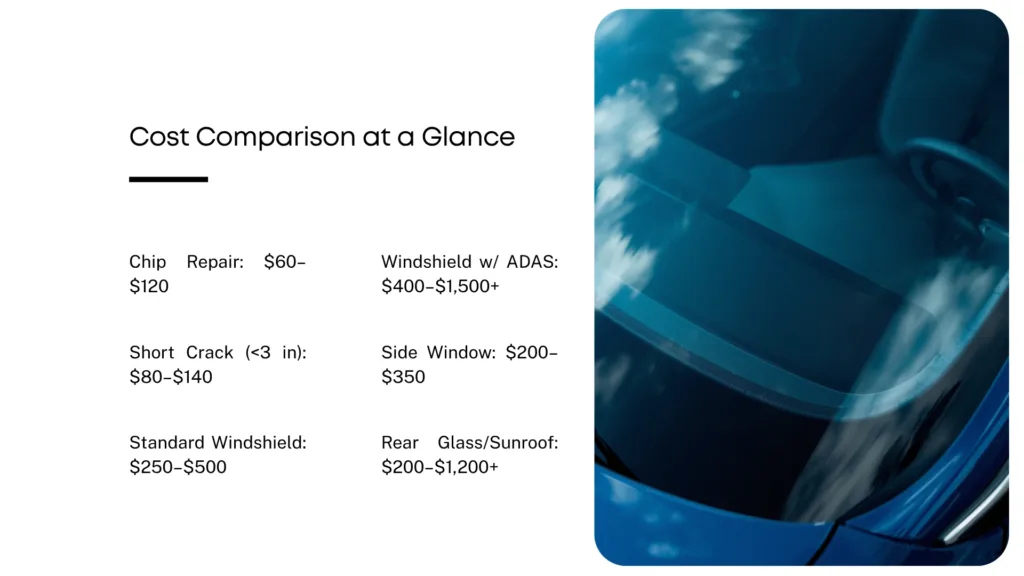
Cost Comparison Table
Here’s a clear, fast reference guide—compare your vehicle and needs in seconds:
- Chip repair: $60–$120
- Short crack (<3 in): $80–$140
- Standard windshield replacement: $250–$500
- Windshield w/ ADAS (w/ recalibration): $400–$1,500+
- Side window: $200–$350
- Rear glass/rear windshield: $200–$500+
- Sunroof/panoramic glass: $350–$1,200+
Actual quotes vary: larger SUVs, premium makes, and ADAS-equipped models can double these figures.
Factors That Drive Price Differences
What pushes prices up or down? Three big drivers:
- Parts choice:
- OEM glass (what the manufacturer installs) may cost $400–$1,000+ more than aftermarket glass—but meets exact specs and may protect your warranty.
- Advanced tech:
- ADAS camera recalibration adds $100–$300 per job; skipping calibration is never worth the risk.
- Shop and region:
- Urban areas and brand-name shops may charge more for labor, but often offer better warranty and faster service.
Specialized glass (think heated, acoustic, or panoramic) also pushes up costs—always get multiple quotes for unique glass.
Shareable Takeaways
- A simple chip repair can save you hundreds—address damage early to avoid high replacement costs.
- “Your safety depends on quality glass—never gamble with bargain parts.”
- Even within the same city, quotes can vary by over $500 for premium vehicles.
Getting accurate quotes is easy: know your model, list your safety features, and ask shops to itemize cost for both parts and labor.
In summary: glass repair and replacement prices are driven by your vehicle’s features, the parts you choose, and the professionalism of your provider—get informed quotes and never sacrifice safety for savings.
Understanding Insurance Coverage for Auto Glass
Knowing when your insurance covers auto glass is the first step to safe, stress-free repairs—and can save you hundreds. Most auto glass claims in 2026 are handled through comprehensive insurance, which covers damage from flying debris, break-ins, storms, or even animal impacts. The majority of drivers with full coverage turn to comprehensive for:
- Windshield chips or cracks
- Side window or rear glass damage
- Broken sunroofs or panoramic roofs
Picture this: a sudden rock chip while driving on the highway—if you have comprehensive coverage, your insurer likely pays for repairs above your deductible.
When Your Policy Covers Glass (and When It Doesn’t)
Not all damage triggers the same coverage or costs. Here’s what to expect based on your insurance:
- Standard comprehensive deductibles: Usually range from $250–$1,000 per claim.
- Windshield repairs: Most insurers now offer $0-deductible repairs, meaning small chips or cracks cost you nothing out of pocket—encouraging fast, safe fixes.
- Windshield replacements: Often subject to the full deductible unless you have a full glass rider or special glass-only policy modification.
- Liability-only policies: Do not cover your own vehicle’s glass damage—you’d pay out of pocket.
A smart strategy: know up front if your policy offers a zero-deductible glass option; this can turn a pricey replacement into a much smaller financial headache.
Other Coverage Sources
Your own insurance isn’t the only possible source of coverage in glass damage scenarios.
- If another driver causes the damage, their property damage liability can cover your glass repair or replacement.
- Direct “accidents” (think: a neighbor’s baseball through your window) may be claimable under the other party’s homeowners or renters insurance.
- Fleet owners and dealerships: Often carry specialized policies that include full glass coverage for business vehicles, minimizing downtime.
“Your insurance isn’t always the only answer—check if another party is at fault before opening your own claim.”
“The right coverage can turn a $1,000+ windshield crisis into a stress-free, same-day fix.”
“Professional glass shops can handle insurance paperwork so you can keep your focus on safe driving.”
Understanding your coverage details—deductibles, options, and potential for third-party payment—gives you the confidence to handle glass damage quickly and affordably. Taking a few minutes now can save your budget, your visibility, and your peace of mind next time the unexpected strikes.
Repair vs. Replacement: Making the Right Choice
When your windshield or auto glass is damaged, the decision between repair and replacement can feel urgent—especially with safety on the line.
Every year, more drivers face unexpected chips and cracks, so knowing exactly when a simple fix is possible can save you time, stress, and hundreds of dollars.
Key Criteria: Repair or Replace?
Most glass shops and insurers follow strict industry standards to decide if a repair is safe:
- Chips smaller than a quarter or cracks under 3 inches can often be repaired
- If the damage is directly in the driver’s line of sight, on the edge, or deeper than the outer layer, replacement is usually required
- For side windows, rear glass, and panoramic roofs, replacement is the norm due to safety and visibility concerns
Envision this: If a crack suddenly spiderwebs across your field of view while driving, that’s a clear call for replacement.
“A fast chip repair today can prevent a $700+ replacement tomorrow.”
When Can Cracks and Chips Be Safely Repaired?
Consider these common rules before deciding:
- Minor chips (up to 1 inch) or single cracks (under 3 inches and not spreading) are prime candidates for quick repair
- If you wait, small cracks may spread—turning a $70 repair into a $800+ replacement
- Repairs are most effective on the original windshield and before moisture or debris gets into the crack
Waiting can undermine both vehicle integrity and your insurance coverage—act as soon as you see damage.
“Don’t delay: 30 minutes for a repair now prevents a full replacement—and keeps your original factory seal.”
Comparing Costs: Repair vs. Replacement
The numbers make the decision even clearer:
- Repairs: $50–$120 out-of-pocket; often $0 with insurance
- Replacements: $250–$800 for standard windshields; up to $2,000+ for high-end or ADAS glass
- Added cost: ADAS recalibration may add $100–$300 to the bill
- With $0-deductible repairs, insurance typically waives the deductible and won’t raise your rate for a single repair
Think about your options:
- If insurance covers repair with no deductible, always use it—no out-of-pocket, no risk
- If your deductible is close to the replacement cost, paying cash for minor jobs often saves you long-term
Picture handing over $60 for a chip repair at lunch—versus the hassle of a $900 claim, a rental car, and hours in the shop later.
The most valuable move is to assess damage early, balance out-of-pocket costs versus your deductible, and always prioritize professional-grade repairs for safety and peace of mind.
How Insurance Claims Affect Costs and Premiums
Filing a claim for auto glass repair or replacement can impact your out-of-pocket costs and, in some cases, your future insurance premiums.
Most insurers in 2026 treat comprehensive-only glass claims as not-at-fault, meaning a single claim is often “forgiven” and won’t affect your rate—especially for minor chips and small cracks.
For example, if your sedan’s windshield cracks and you use your comprehensive coverage for an $800 OEM replacement with a $250 deductible, you’ll pay the deductible at service and, in most states, see no premium increase for your first glass claim.
“A single auto glass claim is usually forgiven by major insurers, but multiple small claims can raise red flags.”
“In states like Illinois, insurers are legally barred from raising your rate just for a windshield claim.”
“Always confirm with your agent—local laws and your claim history can make all the difference.”
State Rules and Insurer Practices
Some states offer strong consumer protection:
- Illinois forbids premium hikes over windshield claims—even for replacement.
- Georgia does not mandate deductible waivers for glass claims, so your normal comprehensive deductible applies unless your policy adds a glass rider.
- Industry trend: Multiple comprehensive claims (glass, hail, theft, etc.) in a few years may lead to rate increases or limited eligibility with preferred insurers.
Picture this: You reach out to your agent about a second glass claim—you’re told multiple recent claims may bump your rate, even if each was small.
Managing Deductibles and Out-of-Pocket Costs
Calculate whether to file a claim or pay cash by comparing these numbers:
- Your deductible amount (often $250–$1,000 national average)
- Actual repair/replacement quote (e.g., $70 for repair, $600 for standard windshield, $1,500+ for luxury/ADAS glass)
- Number of comprehensive or glass claims you’ve filed in the last 3 years
Use this simple decision framework:
- Pay out of pocket if the deductible is close to or exceeds the repair cost, or if you’ve had recent small claims.
- File a claim when the cost is several hundred dollars above your deductible (e.g., $1,000 replacement, $250 deductible).
- Take advantage of $0-deductible repairs if your policy offers them—these are often free and usually don’t impact your rate.
Delaying repairs for minor chips can turn a $70 problem into a $700 replacement—and that can mean a bigger financial hit or the hassle of another claim.
It’s essential to know your deductible, check your claims history, and talk with your insurer or glass shop about how a new claim will impact you—today and in the future.
Armed with your deductible amount and claim history, you can make the safest and most cost-efficient choice every time damage happens.
State-Specific Variations and Legal Considerations
Understanding how auto glass claims work in your state is crucial—laws can dramatically shift repair costs and the claims process.
Some states, like Illinois, have strong consumer protections, while others, such as Georgia, place more responsibility on the vehicle owner.
“Your zip code could be the difference between a $0 deductible and a $500 out-of-pocket bill.”
Key State Laws That Impact Your Glass Coverage
Local rules affect deductibles, whether claims raise premiums, and when insurance must pay:
- Georgia:
- Windshield repairs often come with a waived deductible; replacements are usually subject to your full comprehensive deductible.
- No legal mandate for waived deductible on glass—special glass riders are needed for extra coverage.
- Illinois:
- Insurers must cover repairs or replacement when glass damage impacts safety and visibility.
- Premiums cannot legally increase solely for glass claims.
- Some carriers offer a glass rider for lower or $0 deductible on glass.
- Other examples:
- In many states, if you don’t carry comprehensive or a dedicated glass endorsement, you’ll be paying for glass repairs out of pocket—no automatic coverage, contrary to popular belief.
Myth-Busting: What You Need to Know
Three false beliefs circulate nationally:
- “Every state forces insurers to cover windshield replacement.” (Not true—comprehensive or specialty coverage is required.)
- “All glass repairs are free if you have insurance.”
- “Claims for glass always hike your premium.” (In Illinois and several other states, this is prohibited by state law.)
“Don’t assume every glass chip is fully covered—policies, riders, and state rules determine what you’ll pay.”
How to Check Your Policy and State Terms
Avoid surprises at the repair shop. Always:
- Review your insurance policy for comp coverage or a glass rider.
- Contact your agent for a breakdown on deductibles and local legal nuances.
- Ask glass shops that handle insurance claims—reputable locations are often up-to-date on current state laws.
- Request written estimates outlining out-of-pocket vs. insurance-covered costs.
“Picture this: You call in a repair, expect full coverage, but discover your state’s laws mean you pay hundreds unless you added glass coverage. Always verify your details first.”
Getting familiar with your state’s laws and seeking expert advice ensure you won’t face an unexpected bill or insurance denial—local knowledge is your fastest route to safety and savings.
The Auto Glass Insurance Claims Process: Step-by-Step
Filing an auto glass claim in 2026 is designed to be fast, transparent, and easy—but knowing each step puts you in control.
Start by assessing the damage right away:
- Determine if the glass is repairable (chip smaller than a quarter, crack under 3 inches, and clear of the driver’s direct line of sight)
- If the damage is larger or impacts safety, a replacement may be required
Review your policy details next:
- Check if you have comprehensive or full glass coverage
- Note your deductible amount and whether you’ll pay anything out of pocket
Take clear photos of the damage, your full vehicle, and the VIN.
- Gather your insurance policy number, driver’s license, and any police report if vandalism is involved
Working with Glass Shops and Insurers
A reputable shop makes claiming simple—you can often call them before your insurer.
Leading shops will:
- Verify your coverage and deductible directly with your insurer
- File the claim on your behalf, manage all forms, and handle direct billing—you pay only your share at service time
Ask shops these key questions:
- Are they certified (e.g., by the National Glass Association)?
- What is their experience with insurance claims?
- Do they offer a written warranty and customer satisfaction guarantee?
“A great auto glass shop removes the paperwork headache, so you can focus on safe driving.”
Claim Outcomes and Guarantees
If a repair doesn’t hold or delivers unsatisfactory results, most insurers will:
- Apply what you already paid to the next service
- Authorize a full replacement, with your deductible credited to avoid overpayment
Expect documentation and a clear warranty after completion, covering both the work and the materials used.
Picture this: You leave with a spotless, restored windshield and written proof your repair is built to last.
Any quality shop will offer:
- Clear post-repair instructions
- Fast help with follow-up questions or guarantee issues
The most important takeaway: Professional shops make the claims process seamless, prioritize safety, and provide enduring peace of mind—so you get back on the road with total confidence and transparency.
Practical Strategies for Managing Auto Glass Costs and Claims
Addressing auto glass damage quickly can save you hundreds of dollars over time—and even more when advanced features are involved.
The most effective way to cut long-term costs is to act before small chips turn into windshield-wide cracks. A $70 repair today can prevent a $700+ replacement next month.
Proactive Steps to Keep Glass Expenses Down
Every driver can reduce their risk and future out-of-pocket costs with a few simple habits:
- Repair chips/cracks right away: Most insurance covers repairs for $0 out of pocket, and early intervention prevents the need for replacement.
- Inspect glass after storms or debris: Spotting damage early lets you act before a small problem becomes a safety risk.
- Avoid repeated “small claims”: Filing too many small claims in a short window can affect your premiums—even if a single glass repair usually won’t.
“Timely fixes protect your safety, your wallet, and your peace of mind.”
Know When Extra Glass Coverage Makes Sense
Consider a glass rider or full glass policy if either applies:
- Your vehicle has ADAS, heated, panoramic, or OEM-only windshields; replacements can run $1,000–$2,000+.
- You drive frequently on rough highways where chips are common.
- You live in a state where insurers offer low or zero-deductible glass endorsements for a small extra premium.
A glass endorsement ensures unexpected breakage isn’t a budget-buster.
Insist on Certified, Reliable Repair Providers
Safety comes first—choose a shop known for:
- National Glass Association (NGA) certification
- Visible proof of warranty and insurance claim expertise
- Positive online reviews and professional, clear communications
- Ability to directly bill your insurer for a smooth experience
“Your glass shop should meet high standards—never settle for rushed or uncertified service.”
Keep Documentation and Track Coverage
Stay organized by:
- Saving repair invoices, photos of the damage/repairs, and your policy numbers digitally or in a folder.
- Reviewing your coverage annually—especially after policy renewals or vehicle upgrades.
- Using your shop’s warranty, which is your backup if repairs don’t last.
Picture this: A quick smartphone photo and digital receipt are all you need if future issues or another claim arises.
The smartest drivers never gamble with safety or quality; by acting early, choosing trusted providers, and being coverage-savvy, you’ll keep your view clear, costs minimal, and confidence high.
Choosing the Right Auto Glass Service Provider
Finding a reliable auto glass shop is about more than just price—safety, quality, and peace of mind are on the line every time your windshield or windows are serviced.
Look for providers that earn their reputation through results you can see.
Key Criteria for Trustworthy Shops
To separate the best from the rest, focus on these essentials:
- Certifications: Choose shops certified by the National Glass Association or Auto Glass Safety Council.
- Insurance expertise: Providers should handle claims, offer direct billing, and explain your coverage in simple terms.
- Warranty: Expect at least a lifetime warranty on workmanship and leaks. If a provider can’t guarantee their work, keep looking.
“Safety isn’t negotiable—every auto glass job should be done as if your family is the next to drive the car.”
Essential Questions to Ask
Before you book, ask:
- Do you work with my insurance company, and will you help file the claim?
- Is your glass OEM-grade or equivalent?
- What certifications and training do your technicians have?
- Can you show proof of quality work with recent photos or references?
- What’s included in your warranty?
Visually: Picture a technician showing you the original bill, crystal-clear after photos, and walking you through your insurance paperwork—confidence at every step.
Reputation and Transparency
78% of customers now check online reviews before choosing an auto glass shop.
Scan multiple platforms for:
- Recent customer feedback on professionalism, timeliness, and quality.
- Consistent mention of clean, courteous technicians and transparent pricing.
- Visible before-and-after photos showing real results.
“Professionalism is visible—look for a spotless van, a well-presented technician, and paperwork that makes sense the first time you read it.”
Making Your Choice
- Prioritize shops that communicate clearly, offer written estimates, and welcome your questions.
- Companies like Discount Auto Glass set the bar by providing transparent pricing, warranty coverage, and a focus on customer satisfaction from first call to final inspection.
A trustworthy auto glass provider makes quality, safety, and your peace of mind their top priority—so you drive away with absolute confidence and a clear view, every mile.
Overview of DIY vs. Professional Auto Glass Repair
Thinking about fixing that chipped windshield yourself? DIY repair kits are everywhere in 2026, promising quick fixes for under $40. But not every chip or crack is a safe candidate for home repair.
For small chips (smaller than a quarter) or short cracks (under 3 inches) that are away from the driver’s line of sight, a kit can keep the problem from getting worse until you see a pro. Picture this: you spot a pebble-sized chip on your way to work—using a kit the same day can sometimes save your windshield from a full break.
When to Use DIY Kits—And When Not To
DIY repair kits are best as a:
- Temporary stop-gap for minor chips and short cracks
- Budget option if your deductible exceeds repair cost and you need quick action
They should be avoided if:
- The damage is in the driver’s direct field of vision
- You see a crack longer than 3-6 inches
- You drive a vehicle with ADAS cameras or sensors near the glass
“A DIY kit might buy you time, but it can’t guarantee long-term safety.”
Professional Repairs: What Sets Them Apart?
A certified technician:
- Uses industrial-grade resin and high-pressure vacuum systems for lasting repairs
- Checks for hidden damage affecting airbags, sensors, or advanced features
- Provides a warranty, usually covering the repair as long as you own your car
Statistically, over 85% of chips repaired by professionals do not spread, reducing the risk of a full replacement. In contrast, success rates for DIY kits are lower—especially for longer cracks or complex windshields.
Cost and Decision Factors in 2026
Compare these numbers:
- DIY kit: $20–$40, 20 minutes, no guarantee of safety or passing inspection
- Professional chip/crack repair: $50–$120, usually 30 minutes, warranty included
- Windshield replacement: $250–$800+ (can exceed $1,500 for ADAS-equipped vehicles)
Today’s vehicles with heated windshields, heads-up displays, or ADAS need expert handling—a home kit won’t restore crucial safety technology.
“Saving $50 now can cost $700 or more later if the damage spreads. Protect your safety first.”
When in Doubt, Consult a Pro
Always opt for professional evaluation if you’re unsure—especially with new vehicles or critical glass features.
Making the right choice protects your wallet—but more importantly, your safety and clear vision on the road.
Your Next Smart Move
Managing auto glass repair costs and insurance doesn’t have to be stressful — with the right knowledge, every driver can make confident, cost-smart decisions. Whether you’re weighing a quick chip repair against your deductible or navigating a complex ADAS replacement claim, understanding how auto glass repair costs and insurance work together puts you in full control. At Discount Auto Glass, our certified specialists simplify the entire process, from transparent quotes to direct insurance billing, so you never face unnecessary delays or surprises. Explore everything you need to make the right call — pricing tools, coverage guides, and expert support are all available right here at Discount Auto Glass, your trusted partner for safe, affordable auto glass solutions.
Take these actionable principles into your daily driving:
- Address chips or cracks fast—early repairs are affordable and can prevent expensive replacements.
- Review your insurance for glass coverage each year, ensuring you know your deductible and policy options.
- Request written, upfront estimates and warranties from any glass shop you consider.
- Check your state’s unique laws and coverage options to avoid surprises and maximize your benefits.
- Insist on certified technicians—your safety and visibility depend on expert installation.
Ready to put these strategies to work?
- Inspect your auto glass now for any signs of damage, no matter how small.
- Save your insurer’s and a trusted repair shop’s contact info to your phone for quick access if a crack appears.
- Schedule a quote or insurance review this week to confirm your coverage and avoid out-of-pocket shocks.
- Share your experience or tips with friends and family—being proactive keeps everyone safer on the road.
Every time you choose quality repairs and verified coverage, you invest in both your safety and peace of mind. With clear information, reliable partnerships, and expert help, you’ll always see the road ahead with confidence.
“Choose clarity, drive with confidence, and never settle for less when your safety is at stake—because every mile deserves a clear view.”
FAQ
How much do auto glass repair costs and insurance typically cover for a windshield replacement?
Auto glass repair costs and insurance coverage for windshield replacement depend largely on your policy type. If you carry comprehensive coverage, your insurer will generally pay for the replacement minus your deductible, which typically ranges from $250 to $1,000. Some policies include a glass rider or zero-deductible glass option, meaning auto glass repair costs and insurance can result in a $0 out-of-pocket expense for the driver. For ADAS-equipped vehicles, replacements can exceed $2,000, but comprehensive coverage usually applies to these as well — making it critical to review your policy before assuming you’ll pay full price.
Will filing an auto glass insurance claim raise my premiums?
This is one of the most common concerns around auto glass repair costs and insurance claims. In most cases, a single comprehensive glass claim is treated as a “not-at-fault” event and will not directly raise your premium. Several states, including Illinois, legally prohibit insurers from increasing rates solely due to a windshield claim. However, multiple glass claims within a short period can signal risk to insurers and may result in rate adjustments. Understanding how auto glass repair costs and insurance claims interact with your specific policy and state laws is essential before you file.
What factors most affect auto glass repair costs and insurance deductibles?
Several variables shape both your out-of-pocket auto glass repair costs and insurance deductible responsibility. The type of glass matters significantly — OEM glass is more expensive than aftermarket, and ADAS recalibration adds $100–$300 per job. Your vehicle’s make, model, and year directly influence parts pricing. On the insurance side, your chosen deductible level (set when you purchased the policy) determines what you pay before coverage kicks in. Drivers with higher deductibles often find it more cost-effective to pay for minor repairs out of pocket rather than filing a claim, especially when auto glass repair costs and insurance deductibles are nearly equal.
Can I use insurance to cover auto glass repair costs for side windows and sunroofs?
Yes — comprehensive auto insurance typically covers more than just windshield damage. Auto glass repair costs and insurance claims can also apply to side windows, rear windshields, sunroofs, and even panoramic roofs, provided the damage was caused by a covered event such as a storm, break-in, flying debris, or vandalism. Side window replacements usually range from $200–$350, while panoramic sunroofs can cost $350–$1,200+. The same deductible and policy rules apply, so reviewing your coverage terms is always the smart first step when evaluating auto glass repair costs and insurance options for non-windshield glass.
When is it better to pay out of pocket for auto glass repair instead of filing an insurance claim?
Balancing auto glass repair costs and insurance claims requires a straightforward calculation. If the repair cost (e.g., a $70–$120 chip repair) is lower than or close to your deductible (often $250+), paying out of pocket is almost always the smarter move. Filing a claim makes more financial sense when the replacement cost significantly exceeds your deductible — for example, a $1,500 ADAS windshield replacement with a $250 deductible. Additionally, if you’ve had multiple recent claims, avoiding a new filing can protect your premium rate. Always weigh total auto glass repair costs and insurance implications — both immediate savings and long-term rate impact.
Thank you for choosing Discount Auto Glass. Fast, reliable service with a lifetime guarantee. Visit us or enjoy our mobile service.